

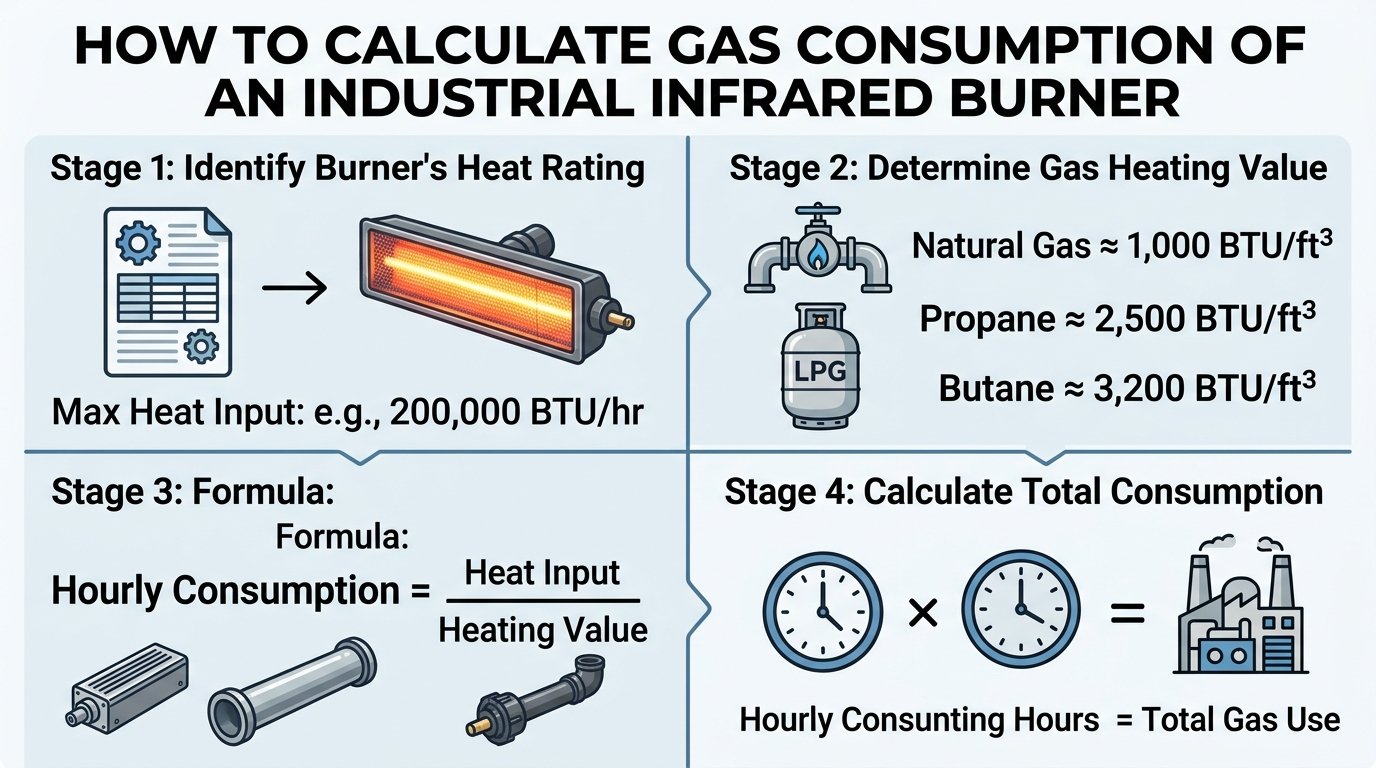
To find the gas consumption of an industrial infrared burner, divide its heat output by your fuel’s energy content. You only need the nameplate rating and your gas’s heating value. With your equipment manual and a recent utility bill, the job takes about 15 minutes.
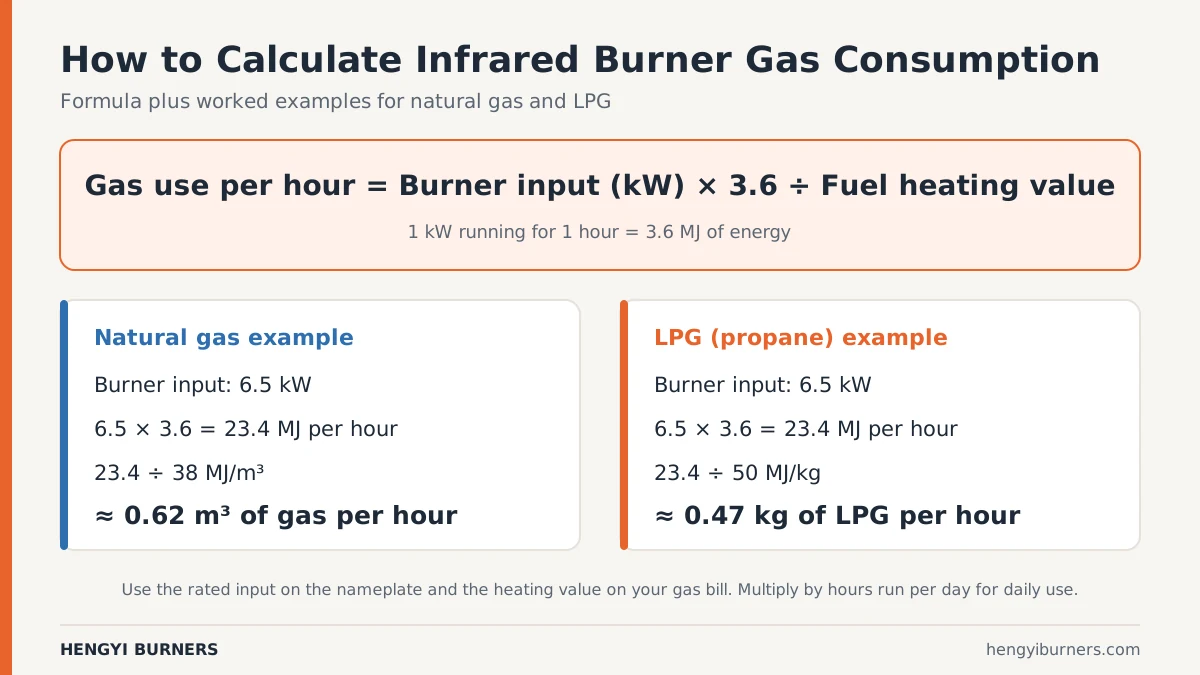
What you need
| Item | How much | Why it’s needed | A substitute |
|---|---|---|---|
| Burner Nameplate | 1 label | Confirms BTUs per hour | Equipment manual |
| Gas Utility Bill | 1 statement | Provides fuel energy value | Local utility website |
| Calculator | 1 device | Ensures math precision | Spreadsheet software |
| Pressure Gauge | 1 tool | Checks operating pressure | None — don’t swap |
| Conversion Table | 1 document | Changes units correctly | Engineering handbook |
Before you start
- First, shut off the main gas supply valve and lock it out. This prevents accidental start-up while you check the internal parts.
- Also, check the American National Standards Institute guidelines for industrial gas equipment. Make sure your setup meets the safety installation rules for your facility.
- Clear all flammable materials from a three-meter radius around the burner housing to reduce fire risks during your inspection.
- Next, find the burner’s model and serial label on the side of the casing. It lists the exact BTU or kilowatt rating, which varies by model.
- If the rating plate is missing or unreadable, don’t guess the output. Instead, ask the manufacturer for a replacement label or a technical specification sheet.
Step-by-Step Gas Consumption Calculation
- Find the rated input capacity on the manufacturer’s label, typically listed in BTUs per hour (BTU/h) for the specific burner model you’re using.
- Identify the higher heating value of your fuel from your utility provider, which is usually measured in BTUs per cubic foot for natural gas.
- Record the current inlet gas pressure using an external manometer, as the manufacturer’s rated capacity assumes a specific pressure, such as seven inches water column.
- Convert the burner’s rated input into the hourly gas flow rate by dividing the BTU/h rating by the fuel’s energy value in BTU per cubic foot.
- Verify the calculation by checking if the result matches the equipment’s designed flow rate, which you can find in the National Institute of Standards and Technology database for gas properties.
- The burner’s rated input capacity represents the gas consumed during steady-state operation.
- Note that if you use propane instead of natural gas, you must divide the BTU/h rating by the higher energy density of propane, which is approximately 2,500 BTU per cubic foot.
- Monitor the burner for 60 minutes while it runs at the set temperature to compare the calculated consumption against the actual meter reading at your main supply line.
- Record the final value in standard cubic feet per hour, ensuring you account for any pressure correction factors provided by the International Organization for Standardization protocols for flow measurement.
How to know it worked
You know the calculation is accurate when the theoretical gas consumption aligns within five percent of the actual meter reading taken over a sustained period of operation. If the difference is greater than ten percent, you must re-examine your pressure readings and the energy content of the gas, as the heat value of natural gas can fluctuate based on local supply composition. A successful calculation shows a consistent flow rate that doesn’t spike unexpectedly when the burner reaches its operating temperature. If you notice the burner cycling on and off too frequently, this indicates the input might be too high for your current heat load, which requires a professional technician to adjust the gas orifice or air-shutter settings. Always verify that the flame appearance remains blue or bright orange without yellow tipping, as yellow flames indicate incomplete combustion and incorrect gas-to-air ratios that will invalidate your consumption estimates.
If something goes wrong
| What happened | Why | What to do |
|---|---|---|
| High meter usage | Gas leak present | Shut off gas immediately |
| Flame is yellow | Poor air mixture | Clean the burner vents |
| Erratic pressure | Regulator is failing | Replace the gas regulator |
| No heat output | No gas flow | Check main supply valve |
| Calculation mismatch | Wrong fuel value | Contact utility company |
How often to do this
You should perform this calculation regularly, or whenever you make significant changes to your production process or gas supply source. The two things that change your consumption results most are the ambient air temperature, which affects the burner’s efficiency, and the inlet gas pressure, which can vary due to seasonal demand on the local utility network. If your facility expands and you add more burners to the same supply line, recalculate the total consumption to ensure your pipes can handle the increased load. If you notice a sudden increase in monthly fuel costs without a change in production volume, perform this check immediately to rule out mechanical inefficiencies or leaks. As a result, this keeps your energy budget predictable and ensures your equipment operates within the safe limits stated by the manufacturer on the unit’s data plate.
Frequently asked questions
Can I use this method for all infrared burners?
Yes, this calculation applies to all standard industrial infrared burners, provided you have the exact BTU rating from the manufacturer’s label. If your burner uses a specialized fuel mixture or is part of a complex integrated system, the manufacturer may provide a different formula in the technical documentation that accounts for secondary air intake or pre-heating stages, so always verify the manual first.
Why is my calculated consumption different from the bill?
The difference often stems from the fact that industrial meters measure volume, while your calculation is based on energy content. In addition, utility companies adjust the billing based on the heat value of the gas, which changes with temperature and pressure. If the variance is more than ten percent, contact your gas provider to confirm the current heating value per cubic foot for your specific service area.
How long does the burner take to reach full flow?
Most industrial infrared burners reach their rated consumption levels within 15 to 30 minutes of ignition. However, this duration depends on the thermal mass of the burner ceramic and the time required for the safety valves to fully open after the pilot flame is established. Don’t attempt to measure consumption until the burner has reached its steady-state operating temperature for at least 20 minutes.
Is it safe to measure gas flow myself?
Yes, you can safely perform this calculation using existing utility data and nameplate information without opening the gas lines. However, if you need to measure actual flow rates using a manometer or other diagnostic tools, you must follow your facility’s safety lockout-tagout procedures. If you’re unsure about handling gas equipment, contact a certified gas technician to perform the inspection for you.
What happens if the gas pressure is too low?
Low gas pressure prevents the burner from reaching its rated output and can lead to unstable combustion. If the pressure drops below the manufacturer’s specified minimum, the burner may fail to ignite or produce incomplete combustion, which creates carbon monoxide. Check the pressure gauge on the inlet side; if it’s below the required range, don’t attempt to force the burner to run.
Does the burner efficiency change over time?
Yes, as the ceramic surface of an infrared burner accumulates dust or debris, its efficiency decreases, which may cause it to consume more gas to reach the same temperature. Also, you should inspect the burner face for blockages regularly. If the ceramic looks damaged or cracked, the burner won’t operate at its rated efficiency and should be replaced by a qualified professional.
Final Thoughts
Keeping a simple log of these figures each month will help you spot efficiency drops before they become costly problems. If you notice your usage climbing unexpectedly, it’s a good idea to schedule a professional inspection. You’ll save money in the long run by ensuring your equipment doesn’t waste precious fuel.
Get the Right Parts from Hengyi Burners
Hengyi Burners manufactures infrared gas burners and burner components in Zhaoqing, China. See the HY-1602 infrared gas burner and HY-2402 infrared gas burner, or browse all infrared gas burners. Contact our team with your fuel type, supply pressure and heating area, and we will recommend a setup and send a quote.
Related guides
2 thoughts on “How to Calculate Gas Consumption of an Industrial Infrared Burner”