
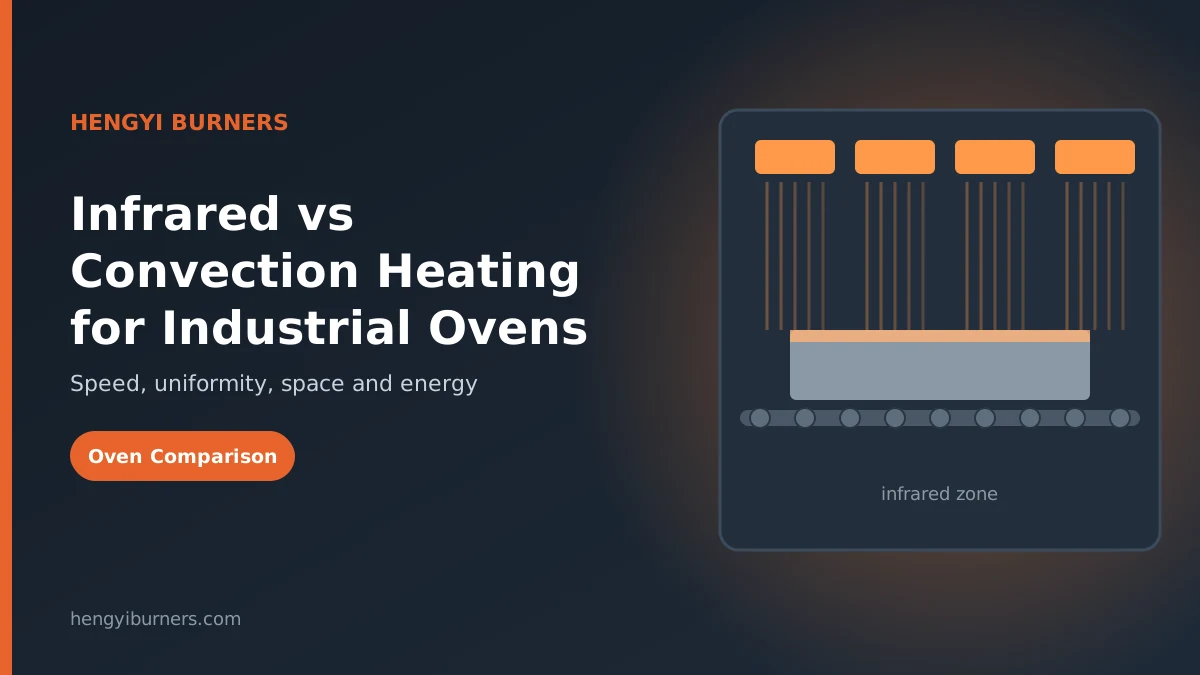
If you’re specifying heat for a curing, drying, or baking process, the choice between infrared vs convection heating for industrial ovens usually comes down to three things: how the part absorbs energy, how much floor space you have, and how tight your temperature uniformity has to be. Both technologies are mature and reliable, and both can be the wrong answer if they’re matched to the wrong product. This article breaks down how each method moves heat, where each one wins, what they cost to buy and operate, and how to decide — or combine them — for your specific line.
Key Takeaways
- Convection heats the air; infrared heats the part. Convection is indirect and even; infrared is line-of-sight and fast.
- Infrared can reach process temperature in seconds to a few minutes; convection ovens typically need 15–45 minutes to stabilize.
- Convection wins for complex geometry, mixed part sizes, and processes needing tight air-temperature control.
- Infrared wins for flat or uniformly shaped parts, high-velocity lines, and water or solvent removal from surfaces.
- Hybrid ovens — infrared boost zones inside a convection tunnel — are the fastest-growing configuration in industrial finishing.
- Operating cost is driven by heat-to-part efficiency, not by the name on the panel. Insulation and exhaust losses often matter more than the heat source.
How Convection Ovens Move Heat
A convection oven heats air, then moves that air across the product with fans and ducting. The part never “sees” the burner or element directly — it sees hot air, and heat transfers through the boundary layer at the part surface.
This indirection is the source of both its strengths and its slowness. Because air surrounds the part, heat reaches recesses, holes, and shadowed areas that a line-of-sight source would miss. Because air has low density and low thermal conductivity compared with a solid, bringing a heavy part up to temperature takes time.
Direct vs Indirect Gas Convection
Direct-fired ovens burn gas in the process air stream and push combustion products through the work zone. They’re thermally efficient — often 70–85% of fuel energy enters the oven — but the moisture and combustion byproducts contact the product. That’s fine for many metal finishing and curing jobs and unacceptable for food or clean-room work.
Indirect-fired ovens use a heat exchanger: combustion stays in a sealed tube and only hot air enters the chamber. Efficiency drops to roughly 55–75%, but the atmosphere stays clean.
Electric Convection
Electric convection ovens use resistance elements in the air stream. They’re simpler, cleaner, and easier to zone, but electricity usually costs more per unit of heat than natural gas in most US industrial markets, so operating cost depends heavily on local utility rates.
How Infrared Ovens Move Heat
Infrared emitters radiate electromagnetic energy in the infrared band. When that energy strikes a surface, it converts to heat at the surface — no air required as an intermediary. This is why infrared feels instant: the energy travels at the speed of light and starts heating the moment the emitter is at temperature.
Three emitter families dominate industrial use:
- Short-wavelength (high-intensity): quartz halogen lamps, roughly 1.0–3.0 microns. Fastest response, highest power density, best for thin films, water flash-off, and powder gel.
- Medium-wavelength: quartz tubes and metal-sheathed elements, roughly 2.5–4.5 microns. The workhorse for curing and preheating.
- Long-wavelength: ceramic and panel emitters, roughly 4.5–8 microns. Slower, gentler, better for thick or heat-sensitive substrates.
Wavelength Matching Matters More Than Wattage
Every material absorbs infrared differently across the spectrum. Water absorbs strongly in the 2.5–3.5 micron band; many organic coatings absorb well in the 3–6 micron range; bare polished aluminum reflects much of the near-infrared band and absorbs poorly. If the emitter’s peak output doesn’t overlap the material’s absorption band, you’re paying for photons that bounce off.
Pro Tip: Before specifying an infrared oven, ask the emitter vendor for a spectral output curve and compare it against your coating or substrate’s absorption data. Two ovens with identical nameplate kW can perform very differently on the same part.
Line-of-Sight Is the Core Constraint
Infrared heats what it can see. A complex casting with deep bores will have cold spots unless you rotate the part, add emitters on multiple sides, or follow the infrared zone with a convection hold. This is the single most common reason infrared projects underdeliver.
Infrared vs Convection: Side-by-Side Comparison
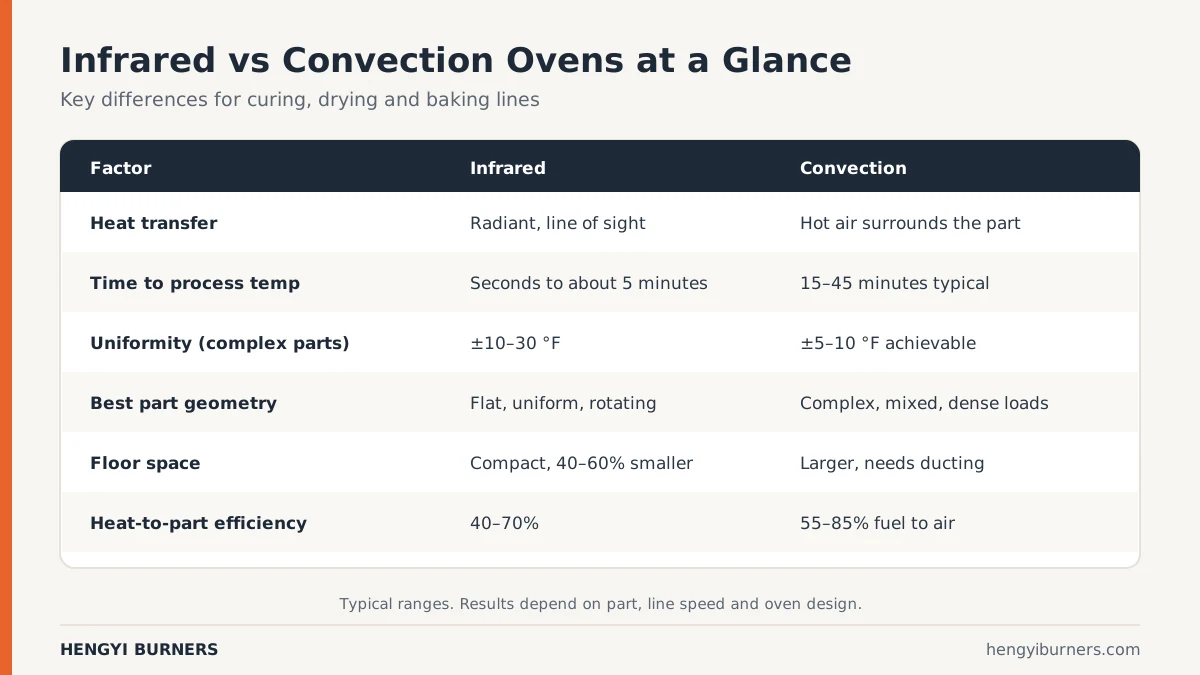
| Factor | Infrared | Convection |
|---|---|---|
| Heat transfer | Radiant, line-of-sight | Air circulation, surrounds part |
| Time to process temp | Seconds to ~5 minutes | 15–45 minutes typical |
| Temperature uniformity | ±10–30 °F on complex parts | ±5–10 °F achievable |
| Best part geometry | Flat, uniform, rotating | Complex, mixed, dense loads |
| Floor space | Compact; can be 40–60% smaller | Larger; needs ducting and plenum space |
| Typical capital cost | $15,000–$250,000 | $25,000–$500,000 |
| Typical operating efficiency | 40–70% heat to part | 55–85% fuel to air |
| Solvent/water removal | Excellent at surface | Good, but air-limited |
| Overspray risk | Higher on thin substrates | Lower |
Ranges above reflect typical North American industrial equipment; your numbers will move with size, controls, and gas versus electric.
When Convection Is the Right Choice
Choose convection when any of these apply:
- Complex geometry. Castings, weldments, assemblies with blind holes, and densely racked loads all need air to reach surfaces infrared can’t see.
- Mixed part sizes on one line. Convection is forgiving of load variation; infrared is not.
- Tight uniformity specs. Aerospace primers, medical device coatings, and some automotive specifications call for air-temperature uniformity that infrared struggles to hold on shaped parts.
- Long dwell processes. Thermoset curing, some powder chemistries, and stress-relief cycles need time at temperature, not just a fast surface ramp.
- Solvent-laden atmospheres. Convection ovens can be designed with high exhaust and LEL monitoring to handle flammable vapor safely.
When Infrared Is the Right Choice
Choose infrared when these describe your process:
- Flat or uniformly shaped parts. Coil stock, panels, webs, and profiles are ideal.
- High line speed. Infrared zones fit into short footprints between processes.
- Surface-driven processes. Water flash-off, powder gel, preheating before forming, and thin-film curing are all surface or near-surface events.
- Zoned control. Infrared emitters can be switched per zone in milliseconds, letting you profile heat along a conveyor.
- Retrofits with no floor space. Infrared boosters mount over existing conveyors without new ductwork.
Warning: Don’t use high-intensity short-wave infrared on heat-sensitive substrates or parts with uneven mass distribution without a trial. Localized overheating and warping are the most common infrared failure modes.
Hybrid Systems: The Practical Middle Ground
Most new industrial oven projects in finishing and converting are neither pure infrared nor pure convection. They’re hybrids, and the pattern is consistent:
- Infrared boost zone first to flash off water or solvent and gel the coating.
- Convection hold zone second to bring the whole part and coating to cure temperature evenly.
- Optional infrared touch-up zone at the exit for edge or thin-spot cure.
This layout typically cuts total oven length by 30–50% compared with an all-convection line while holding uniformity close to convection-only performance. It also reduces the risk of skinning — the defect where a coating surface cures before the underlying solvent escapes, trapping bubbles.
Energy, Cost, and Efficiency Realities
Capital cost is only part of the picture. The number that decides your operating budget is heat-to-part efficiency: how much of the energy you buy actually ends up in the product.
| Cost Driver | Infrared | Convection |
|---|---|---|
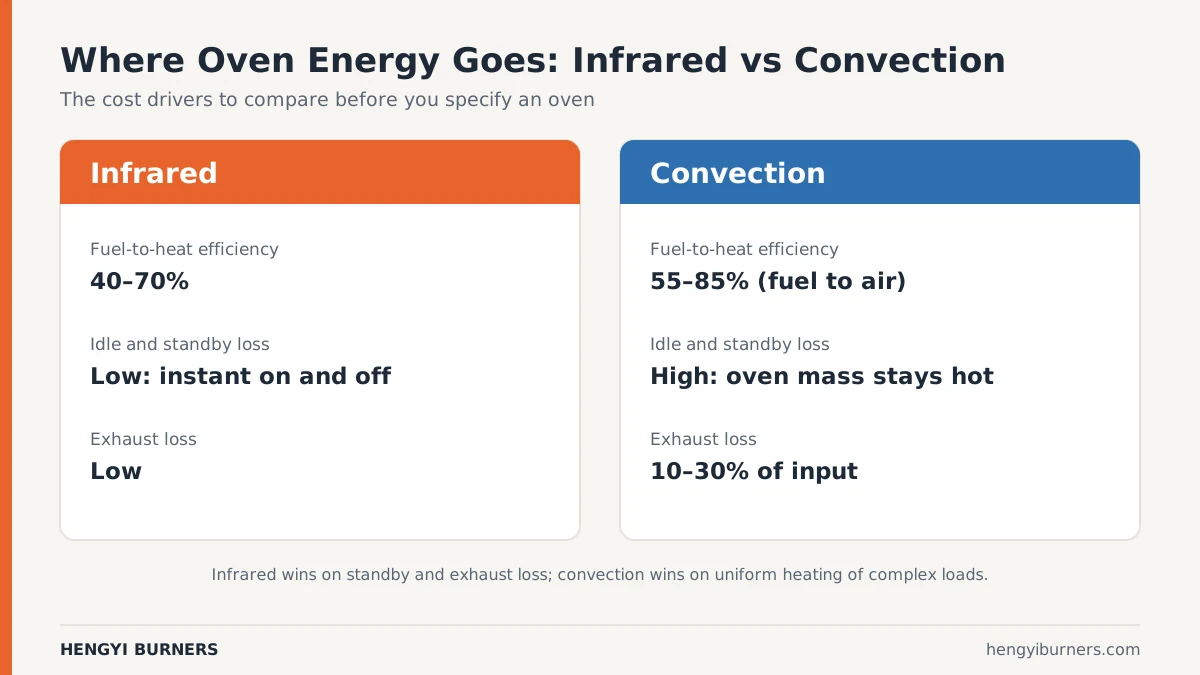
| Fuel-to-heat efficiency | 40–70% | 55–85% |
| Idle/standby loss | Low; instant on/off | High; oven mass must stay hot |
| Exhaust loss | Low | Significant; 10–30% of input |
| Maintenance | Emitter replacement, reflectors | Fans, belts, burners, filters |
| Emitter/element life | 5,000–20,000 hours | 10,000–30,000 hours |
The U.S. Department of Energy publishes process heating guidance that consistently shows standby and exhaust losses as the largest avoidable inefficiency in industrial ovens — larger than the choice of heat source itself. Insulate the shell, seal the entries, and control exhaust before you blame the emitters.
Pro Tip: Meter your oven for one full production week before and after any change. Real submetered data beats any vendor efficiency claim, including ours.
How to Specify and Size Your Oven
Work through these steps in order:
- Define the process window. What temperature must the part reach, and for how long? Surface-only or through-thickness?
- Characterize the part. Material, thickness, mass, geometry, coating type, and absorption behavior.
- Calculate the load. Pounds per hour of product plus pounds per hour of water or solvent to be evaporated. Solvent load drives exhaust and safety design.
- Pick the heat transfer mode using the geometry and speed constraints above.
- Size the zones. Infrared zones are sized by power density (watts per square inch); convection zones by air changes per minute and Btu per hour.
- Design for uniformity. Add plenums, baffles, or part rotation as needed.
- Plan safety and compliance. Flammable vapor handling, interlocks, and guard packages aren’t optional.
Questions to Ask Every Vendor
- What is the guaranteed uniformity at the part surface, and under what load?
- What is the spectral output of the emitter, and how does it match my coating?
- What is the documented heat-to-part efficiency at my production rate?
- What happens to the process if line speed drops by 20%?
- What is the preventive maintenance schedule and parts cost over five years?
Frequently Asked Questions
Is infrared heating cheaper to run than convection?
Not automatically. Infrared avoids heating air it doesn’t need, so it often wins on surface-heating tasks. But convection can be more fuel-efficient per delivered Btu when it runs continuously at full load with good insulation. The deciding factor is your duty cycle and how much of the heat actually reaches the part.
Can infrared and convection be used in the same oven?
Yes, and it’s common. Most hybrid tunnels place an infrared boost zone ahead of a convection hold zone. This combines fast surface heating with even through-part cure. Controls must coordinate zone temperatures and conveyor speed, but the hardware is straightforward and widely available.
What part shapes work worst with infrared?
Parts with deep recesses, blind holes, internal channels, or highly varied mass distribution. Infrared heats only what it can see, so shadowed areas lag. Rotating fixtures, multi-sided emitter banks, or a convection follow-on zone can compensate, but a pure infrared oven is usually the wrong pick for these geometries.
How long does an infrared oven take to reach temperature?
Short-wave quartz emitters typically reach full output in 1–5 seconds, and the oven chamber stabilizes in under a minute. Convection ovens often need 15–45 minutes to reach setpoint from cold, depending on mass and insulation. That difference matters most for batch and job-shop work with frequent starts and stops.
Do I need a trial before buying?
For any new coating, substrate, or part geometry, yes. Bench-scale infrared trials are inexpensive and reveal absorption problems, skinning, and warping that no datasheet predicts. Most reputable oven builders will run sample parts before quoting a full system.
What about solvent-laden processes?
Both technologies can be built to handle flammable vapors, but the design requirements differ. Convection ovens rely on high exhaust rates and lower flammable limit monitoring. Infrared ovens concentrate heat at the surface, which can raise surface solvent concentration quickly, so ventilation design and interlock logic deserve extra attention.
Matching the Technology to Your Line
The honest answer is that most industrial heating problems are solved by matching the heat transfer mode to the geometry and the process physics, not by picking a favorite technology. Flat parts moving fast want infrared. Complex parts needing even cure want convection. A great many lines want both, staged in the right order.
If you take one action from this article, make it this: pull the actual part, coating, and production rate data for your process, then ask two or three oven builders to run a sample and quote against those numbers. A bench trial costs a fraction of a mis-specified oven, and it will tell you more about infrared versus convection for your application than any comparison table can.
Get the Right Parts from Hengyi Burners
Hengyi Burners manufactures infrared gas burners and burner components in Zhaoqing, China. See the HY-1602 infrared gas burner and HY-2402 infrared gas burner, or browse all infrared gas burners. Contact our team with your fuel type, supply pressure and heating area, and we will recommend a setup and send a quote.
Related guides
3 thoughts on “Infrared vs Convection Heating for Industrial Ovens”