

Choosing the right infrared burner size for an industrial oven is determined by calculating the total heat load in BTUs per hour and matching that load to the chamber’s volume and insulation rating. If your oven operates at high temperatures, you must size for maximum throughput; if you only need gentle heat, you size for the minimum steady-state requirement. This varies by model — check the label for the manufacturer’s specified input range and thermal efficiency rating.
Choosing the right infrared burner size
When picking components, you must balance raw power against the physical limitations of your oven enclosure. While a larger burner provides faster recovery times, it can also lead to uneven heating or localized hot spots if the airflow isn’t properly managed within the cavity.
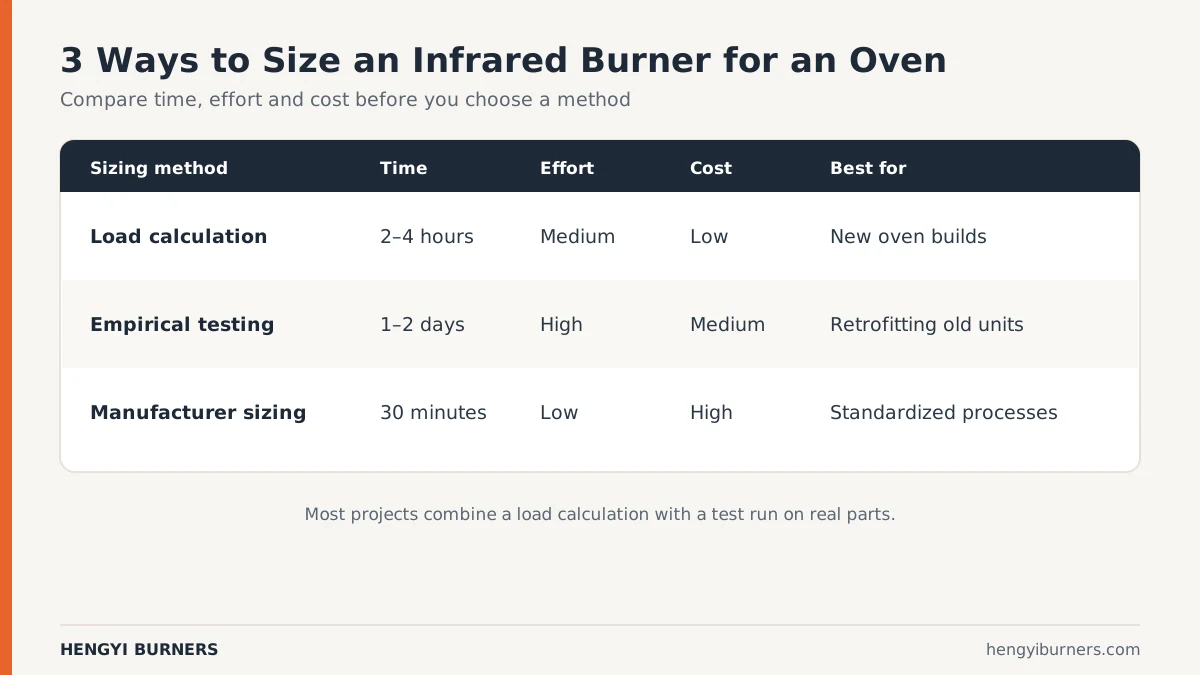
| Method | How long | Effort | Cost | Best for |
|---|---|---|---|---|
| Load calculation | 2-4 hours | Medium | Low | New oven builds |
| Empirical testing | 1-2 days | High | Medium | Retrofitting old units |
| Manufacturer sizing | 30 minutes | Low | High | Standardized processes |
If you choose the load calculation method, you must account for the mass of the product, the specific heat capacity of the materials, and the heat loss through the walls. A common mistake is ignoring the “ramp-up” phase; users often size heaters for steady-state operation, failing to realize that initial startup requires 20% to 30% more energy to overcome thermal inertia.
Use this decision rule: if your production cycle involves frequent door openings, prioritize high-wattage density to recover temperature quickly. If your process requires precise uniformity for delicate components, opt for lower-wattage elements spread across a wider surface area to prevent scorching.
You can distinguish between these needs by measuring your cycle time. If your recovery period exceeds 15% of the total process time, your current heater is undersized. Conversely, if the temperature overshoots the setpoint by more than 5 degrees during idle periods, your heating element is likely too powerful for the control system to manage effectively. Always verify that your power supply can handle the peak load during the initial cold-start phase to avoid tripping breakers.
Calculating thermal load requirements
Measure the internal volume of the oven in cubic feet and the total surface area in square feet. You must account for every exterior wall, including the floor and ceiling, as these are primary conduits for heat migration.
Determine the required temperature rise and the time needed to reach that temperature for your heaviest batch. If your process requires a ramp rate exceeding 10 degrees Fahrenheit per minute, you must calculate for the peak load rather than the steady-state load.
Calculate the total heat loss by multiplying the surface area by the temperature difference and dividing by the insulation’s R-value. A common mistake is ignoring the thermal bridge created by metal fasteners or door seals. These gaps can increase heat loss by 15% even in well-insulated units.
Add the energy required to heat the product mass based on its specific heat and weight. If you’re processing materials with high moisture content, you must also factor in the latent heat of vaporization, or your burner will stall during the drying phase.
Select a burner with a maximum BTU rating at least 20% higher than your calculated total to allow for recovery time. If your operation involves frequent door openings, increase this safety margin to 35%.
This method ensures you don’t undersize the equipment, which leads to failed batches and ruined inventory. The main trade-off is the time required for precise measurements versus the risk of buying a unit that can’t maintain temperature. If your result is within 10% of the burner’s limit, always choose the next size up.
Testing for heat distribution
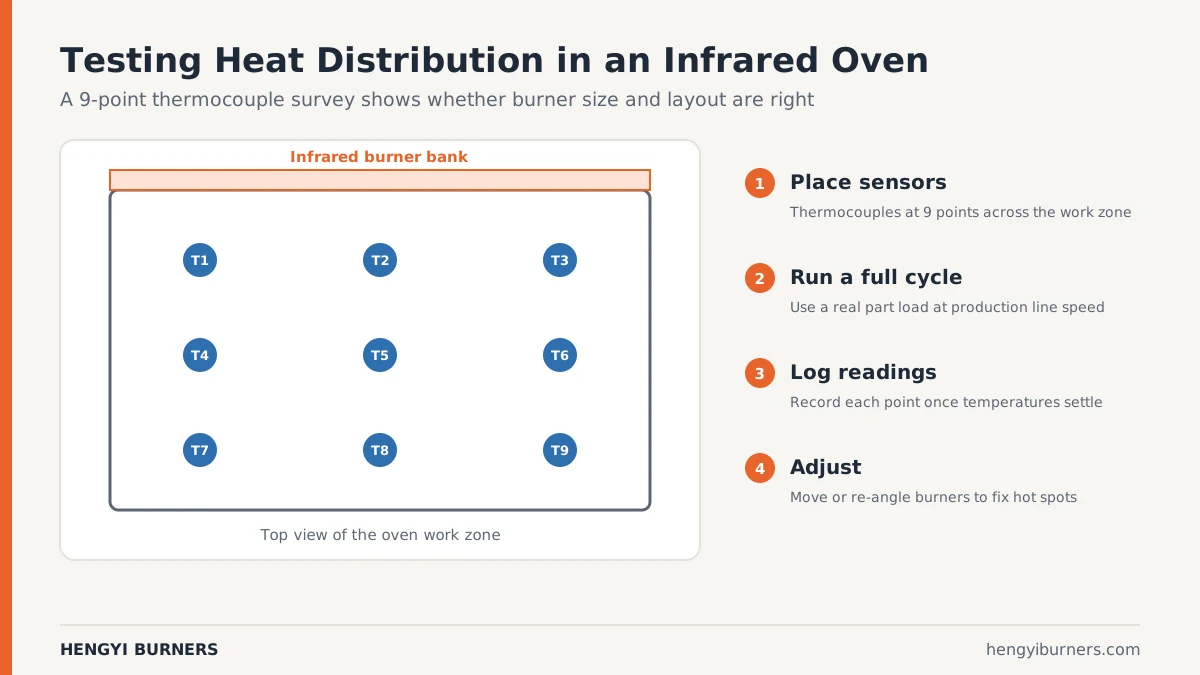
Place thermal sensors at every corner and the center of the oven chamber to monitor temperature consistency. Use high-temperature thermocouples rated for at least 50 degrees above your maximum process temperature to prevent sensor failure during the test.
Run the burner at the minimum setting for one hour and record the temperature stability. If the variance between the center and corners exceeds 5 degrees, your burner is likely under-modulating, which causes localized cold spots.
Increase the burner output in 10% increments, allowing the oven to stabilize for 30 minutes at each step. This duration is critical; shorter windows fail to account for the thermal mass of the oven walls, leading to false readings.
Note any areas where the temperature exceeds your process limits, as these indicate improper burner placement or size. A common mistake is adjusting the burner before checking the airflow. If the heat is uneven, verify that your circulation fans are running at full speed first.
Adjust the burner position or install baffles if the heat distribution remains uneven during peak output. If the temperature is too high near the burner, add a heat shield or baffle to redirect the flow. If the temperature is too low at the far end, increase the fan pitch to push air further.
This method works best for existing ovens needing performance upgrades or processes with strict tolerances. It’s highly accurate because it uses real-world data from your specific machine. The primary cost is significant downtime, often totaling eight hours of production loss. If you can’t afford this, use a portable infrared thermal camera to identify hotspots without stopping the line.
Relying on engineering specifications
Contact the oven manufacturer and provide your exact process temperature and product throughput requirements. Request a sizing report based on the oven’s specific insulation thickness and door seal integrity. These reports often reveal if your current heat loss exceeds the burner’s output capacity.
Compare the recommended burner model against your existing gas line pressure to ensure compatibility. If your supply pressure is below 7 inches of water column, you may need a booster pump, which adds significant mechanical complexity.
Install the burner according to the manufacturer’s exact clearance specifications to prevent fire hazards. Maintain at least 18 inches of clearance from combustible materials. If your facility layout forces a tighter fit, you must install a heat shield, or you risk voiding your insurance policy.
This is the fastest method and minimizes the risk of human error in your calculations. It’s ideal for companies that need to maintain strict warranty compliance and safety standards. The trade-off is the higher cost of proprietary parts and the reliance on third-party engineering.
If you lack the necessary training or specialized gas-fitting tools, you must hire a certified technician. Gas systems present a serious risk of explosion or carbon monoxide buildup. A simple leak at a pipe joint can lead to a catastrophic failure if the burner ignites in a saturated environment. Always verify that the technician performs a manometer test on the line before the final startup.
Deciding on your burner capacity
For those in a hurry, relying on manufacturer specifications is the fastest path because it leverages existing engineering data. If you’re doing this for the first time, perform a basic load calculation first. It helps you understand the energy demands of your specific process before you spend any money. When you want the best possible result regardless of the effort, combine a load calculation with empirical testing to ensure your burner size is perfectly matched to your production cycle.
The primary trade-off is between the speed of manufacturer-provided data and the granular control you get from manual testing. If you skip the calculation and simply guess a size, you’ll likely encounter either inefficient fuel usage or an oven that never reaches the required temperature.
To choose correctly, use this decision rule: if your process involves high thermal mass, such as heating dense steel parts, always size for the peak load plus a 20% safety margin. If your process is steady-state, like continuous drying, prioritize turndown ratio over raw capacity. A common mistake is sizing for the maximum possible throughput rather than the actual average. This leads to short-cycling, which degrades your igniter and wastes fuel. In that case, you must downsize the nozzle or install a modulating control valve to stabilize the heat.
Rules for consistent heating performance
Regardless of the method you pick, always verify your local codes regarding industrial gas equipment. You must prepare the workspace by ensuring the oven is on a level surface and that all gas supply lines are purged of air before the first ignition. During the initial heat-up, check the burner flame color frequently; a yellow flame often indicates incomplete combustion, whereas a crisp blue flame signals proper air-to-fuel ratios. At the end of the process, always perform a safety shut-off test to ensure the flame failure detection system works as intended.
If you ever find that the oven isn’t holding temperature, check the door seals for leaks before blaming the burner size. Most issues with inconsistent heat are due to air leaks rather than the burner itself. If you suspect a malfunction in the ignition or safety controls, don’t attempt to repair these yourself, as ignition transformers can hold a lethal charge even when the unit is unplugged. Instead, contact a qualified industrial maintenance technician to handle internal repairs or component replacements.
How often should I calibrate my oven sensors?
You should calibrate your sensors regularly to maintain process accuracy. If your oven operates at temperatures above 500°F or runs 24 hours a day, check the sensor accuracy whenever you notice it.
Can I use a larger burner than recommended?
No, using an oversized burner can cause rapid cycling of the heating elements, leading to premature wear and uneven temperature distribution throughout the chamber.
Why is my oven failing to reach the target temperature?
The most common cause is a loss of heat through poor door seals or damaged insulation. Check these physical barriers before assuming your burner size is the issue.
Is it safe to install an infrared burner myself?
No, the installation of industrial gas burners requires specialized knowledge and adherence to national fire codes. Improper installation can result in gas leaks or fire, so always hire a licensed professional.
What happens if the burner size is too small?
An undersized burner will force the system to run at maximum capacity constantly, which prevents the oven from recovering temperature after a load is introduced.
How long does an industrial infrared burner last?
With proper maintenance and clean fuel, most burners last through years of standard use. This varies by model — check the label for the expected service life.
Proper sizing is the foundation of an efficient industrial operation. By taking the time to calculate your load and verify your results through testing, you ensure that your oven remains a productive asset for years to come.
Burner Sizing: Summary
Once you’ve selected your equipment, don’t forget to consult with a certified technician before you finalize the installation. They’ll help ensure your gas lines and ventilation systems are perfectly aligned with your new setup. It’s a smart way to keep your oven running safely and efficiently for years to come.
Get the Right Parts from Hengyi Burners
Hengyi Burners manufactures infrared gas burners and burner components in Zhaoqing, China. See the HY-1602 infrared gas burner and HY-2402 infrared gas burner, or browse all infrared gas burners. Contact our team with your fuel type, supply pressure and heating area, and we will recommend a setup and send a quote.
Related guides
3 thoughts on “How to Choose the Right Infrared Burner Size for Industrial Ovens”