
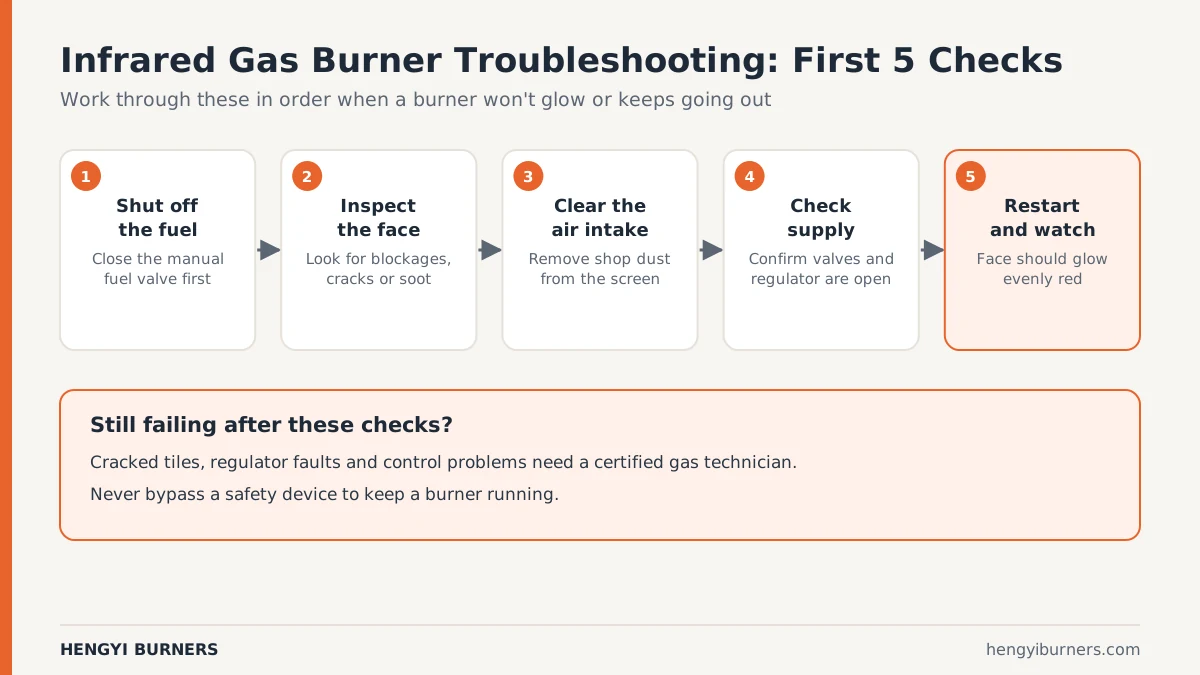
When your unit won’t glow red or blows out right after ignition, start with three checks. Shut off the manual fuel valve, inspect the burner face for blockages or cracks, and clear shop dust from the air intake screen. The most common cause of combustion failure is a wrong air-to-fuel ratio. Blocked venturi openings or sudden drops in supply pressure usually cause it.
Why infrared gas burners stop working
Infrared burners rely on premixing fuel and air before the mixture pushes through a porous ceramic tile or metal fiber matrix. When your equipment won’t stay lit, the cause is almost always one of three things. Look for restricted air volume, wrong supply line pressure, or a damaged emitter tile.
The first major cause is dirt accumulation. Industrial work floors collect airborne lint, metal shavings, and dry particulate. The burner draws this shop dirt directly into the mixing chamber through the venturi air shutter. Over time, dust coats the inner screen. This cuts the oxygen supply. As a result, weak yellow flames float on top of the ceramic instead of heating it to an even glow.
The second primary cause is unstable gas pressure. Infrared units require a tightly held operating pressure to sustain surface combustion. If your line pressure spikes, the high velocity blows the flame off the tile face before it can heat the ceramic. If pressure dips too low, the flame flashes back inside the mixing tube behind the face. You can review standard commercial installation thresholds directly through the OSHA technical manual on heat processing to understand factory airflow and fuel hazards.
Finally, thermal shock or mechanical vibration cracks the ceramic tiles. When a tile splits, raw gas escapes through the crack without mixing properly. This causes uneven heat and sudden flame sensor dropouts.
Clear external debris from the air shutter
This fix is for equipment operators who see weak, lifting yellow flames or smell unburned gas near the unit intake. You don’t need technical training to complete this basic surface cleaning, and you won’t have to disassemble the internal manifold.
Begin by turning off the electrical switch and closing the main fuel quarter-turn shutoff valve. Let the burner body cool completely to room temperature for at least 45 minutes. Locate the primary air shutter near the inlet pipe. Use a dry, soft-bristle paint brush or a portable vacuum to clear away all lint, loose grime, and foreign debris from the intake ports. Never use liquid cleaners or soapy water here, as moisture will ruin the porous ceramic surface inside.
To tell if this fix worked, reopen the fuel line and restart the system. The burner should ignite cleanly within 4 to 6 seconds. Small, sharp blue flames appear across the face first, then the matrix turns an even, glowing red. If the intake screen stays bent or clogged with sticky grease, don’t pry it open yourself. Instead, call a certified commercial gas technician to clean the inner chamber safely.
Verify external supply valves and regulator locks
This fix is for situations where the burner clicks to ignite but never lights, or shuts off three seconds after sparking. It addresses fuel starvation outside the burner body without opening any pressurized lines.
First, trace the exterior fuel feed pipe backward from the burner housing to the line isolation valve. Verify that the quarter-turn lever aligns fully parallel with the pipe; partially closed handles choke the fuel flow enough to starve infrared emitters. Next, check your external supply regulator vent. Outdoor lines or humid processing bays often suffer from clogged regulator vent screens due to insect nests or frozen condensation. Clear the vent screen with a stiff nylon brush so the internal diaphragm can move freely.
If the supply gauge shows normal pressure, leave the regulator settings alone. However, if your main line gauge reads zero, contact your gas utility or plant piping team instead of adjusting the regulator spring yourself. Modifying commercial gas regulators without a manometer risks severe equipment damage and voids your system’s factory warranty. You’ll know the issue is resolved when the burner ignites without rumbling, and the flame stays steady across the entire tile grid without dropping the safety lockout switch.
Replace visibly damaged ceramic face tiles
This fix is for older heating units that produce visible hot spots, loud popping noises, or irregular flame tongues coming out of tile seams. It handles structural matrix failure when simple cleaning doesn’t restore normal operation.
Examine the ceramic face under a bright flashlight while the machine is powered off and cool. Look for visible cracks, chipped corners, or crumbling tile gaskets around the perimeter. Ceramic tiles can’t be patched with household glue or standard high-temp silicones; burning sealants produce hazardous toxic fumes and destroy burner combustion dynamics. A complete matrix replacement is worth the expense when the outer metal casing remains straight and rust-free, but it isn’t worth doing if the housing itself is warped or heavily corroded.
This fix is NOT for general plant laborers or home workshop users. Replacing infrared matrix panels requires specialized refractory cement, precision torque patterns, and replacement of brittle perimeter ceramic gaskets. If you discover broken tiles, turn off the fuel source immediately and hire a licensed industrial combustion contractor. They possess the proper tools to reseat the matrix assembly without causing deadly internal flashback fires.
Mistakes that ruin infrared burners
Spraying the glowing ceramic face with water to clean it causes instant thermal shock that shatters the brittle refractory matrix into fragments. Avoid this by only using a soft-bristled brush or low-pressure vacuum when the unit is cold.
Using compressed air at pressures over 30 PSI directly against the burner face pushes accumulated dust deep into the microscopic pores, permanently choking the ceramic. If you must use air, keep the nozzle at least six inches away and use a gentle, sweeping motion.
Increasing regulator delivery pressure to overcome a dirty burner face creates high internal housing pressure and blows the combustion flame off the tile entirely. This causes the gas to pool inside the chassis, creating a significant fire risk.
Patching surface cracks with consumer-grade furnace cements clogs the heat-radiating micro-holes. This blockage forces gas to find an alternative exit, leading to dangerous internal backfiring that can melt the burner’s internal manifold.
Prevent combustion and heating issues
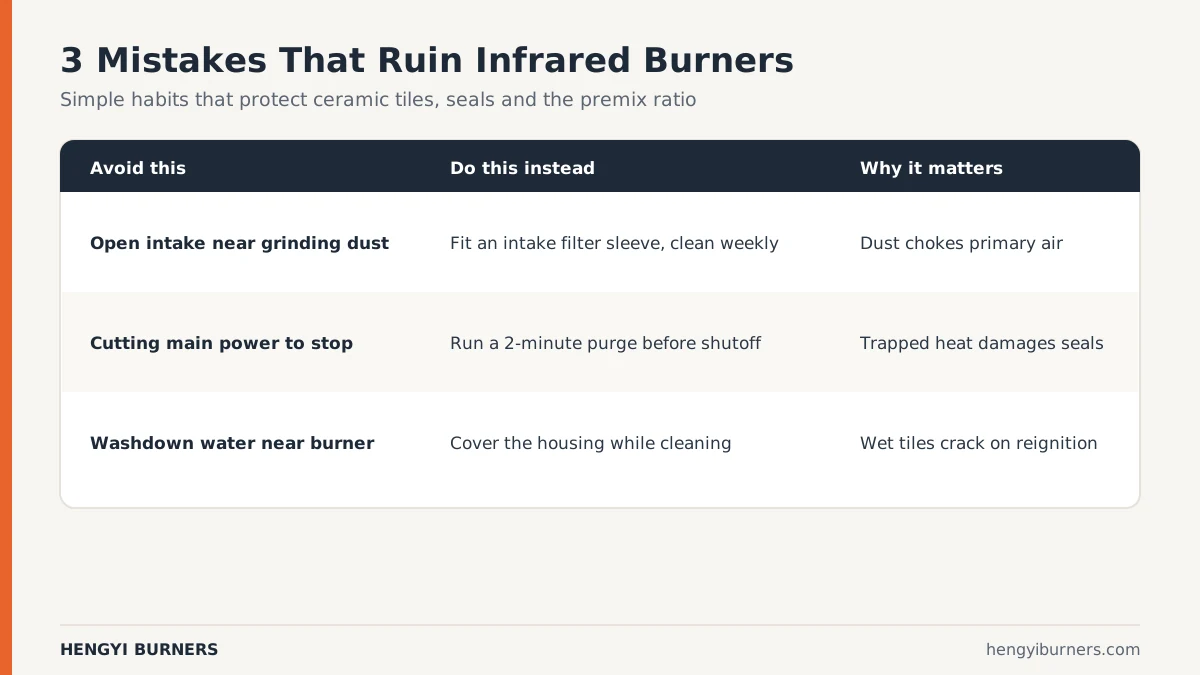
A reliable maintenance routine prevents unexpected downtime and preserves the burner structure. Most premature failures stem from operating in contaminated shop air or neglecting basic visual checks.
| If you’re doing this | Do this instead | Why |
|---|---|---|
| Leaving the intake screen open to ambient grinding dust | Install an external intake filter sleeve and clean it weekly | Dust buildup chokes primary air and ruins the premix ratio |
| Turning the burner off by cutting the main power switch instantly | Run the blower purge cycle for two minutes before shutoff | Trapped heat soaks backward into the manifold and damages internal seals |
| Allowing washdown water to splash against the burner body | Shield the burner housing with waterproof covers during room cleanup | Wet ceramic tiles crack instantly upon subsequent system reignition |
When the air density changes, the burner runs rich, leading to carbon buildup that insulates the sensor and triggers false overheating alarms.
Use this simple decision rule: if you notice a yellow flame tip, check your intake filter first. If the filter is clean but the yellow persists, your gas pressure regulator needs a manual adjustment.
Frequently asked questions
Can I clean ceramic infrared burner tiles with liquid soap?
No, you must never apply water, soap, or chemical cleaners to ceramic burner tiles. Porous ceramic materials absorb liquids quickly and can’t dry out thoroughly before operation. When you fire up a wet tile, the trapped water turns to steam, creating internal pressure that cracks the matrix from the inside out. Clear loose dust only with a soft brush or low-pressure suction.
Why does my infrared burner pop loudly when shutting off?
A loud pop during shutdown means the flame flashed back into the mixing tube as the gas valve closed. This occurs when the fuel flow drops faster than the flame front speed, allowing the flame to travel backward behind the ceramic face. A slight pop can happen occasionally on older models, but persistent loud banging points to loose tile seals or incorrect shutoff valve timing.
How often should industrial infrared burners be serviced?
Industrial infrared burners should receive professional maintenance regularly under normal operating conditions. If your manufacturing environment contains heavy dust, airborne oil, or fine fiber particles, shorten this service interval accordingly. Routine service must include inspecting the ceramic face, testing line safety valves, checking manifold pressure with a manometer, and clearing the venturi tube.
What causes an infrared burner to produce yellow flames?
Yellow flames mean the burner isn’t getting enough combustion air to fully burn the gas supply. An infrared burner needs a strictly controlled premix of fuel and oxygen to produce an even blue flame base beneath a glowing red surface. Check for dust clogging the air shutter, obstructions inside the venturi throat, or an oversized gas orifice before testing further.
Is it safe to operate an infrared burner with a small crack?
No, running a burner with a visible crack in the ceramic matrix is unsafe. Cracks allow unmixed gas to escape in concentrated streams, which destabilizes the flame sensor and causes uneven product heating. More critically, cracks let the flame burn through to the rear mixing plenum, which can melt the steel housing or cause an explosion inside the burner case.
How long does an industrial infrared burner take to glow red?
An industrial infrared burner takes between two and five minutes to achieve a full, uniform red glow across its entire surface. This duration assumes standard line pressures and ambient warehouse temperatures. If the matrix fails to reach an even red color after five minutes, your supply gas pressure may be low, or the venturi is clogged with dirt.
Troubleshooting Summary
Careful monitoring of flame color, regular visual inspections of the tile surface, and keeping the air intake free of particulate matter will keep your heating equipment running efficiently. When physical cracks or deep manifold blockages appear, always call a licensed industrial burner technician to handle internal adjustments safely.
Related guides
Get the Right Parts from Hengyi Burners
Hengyi Burners manufactures infrared gas burners and burner components in Zhaoqing, China. We stock replacement honeycomb ceramic plates, ignition needles and ignition controllers, plus complete infrared gas burners. Contact our team with your fuel type, supply pressure and heating area, and we will recommend a setup and send a quote.
5 thoughts on “Industrial Infrared Gas Burner Troubleshooting Guide: Fixes”