

A gas burner that clicks but won’t light, or won’t click at all, almost always traces back to one of a handful of causes: a wet or dirty igniter, a clogged burner cap, a misaligned spark electrode, a weak or tripped power source, or a gas supply that isn’t reaching the burner. Most of these are things a careful homeowner can diagnose in about fifteen minutes with nothing more than a dry cloth, a soft brush, and a straightened paper clip. The rest require a technician, and a few require you to stop and call one immediately.
Key Takeaways
- No spark at all usually means a power, ignition-module, or wiring problem — not a gas problem.
- Spark but no flame points to a blocked gas port, a wet igniter, or a burner cap that isn’t seated flat.
- Clicking with a delayed whoosh is normal on some ranges; a boom or pop is not, and signals delayed ignition.
- Cleaning the burner cap, head, and igniter with a dry brush fixes the majority of no-light complaints.
- If you smell gas at any point, stop, ventilate, and leave the building before calling for help.
- Anything past the burner assembly — the module, the valves, the manifold — belongs to a licensed technician.
How a Gas Burner Ignition System Works
Understanding the sequence makes diagnosis much faster. When you turn a knob, three things happen in order: the spark module sends high voltage to the igniter electrode, the gas valve opens and releases gas through the burner head, and the spark arcs across a small gap to light the mixture. If any one of those three steps fails, you get either silence, clicking without flame, or flame without clicking.
Most modern ranges use electronic ignition rather than a standing pilot light. That means there’s no constantly burning flame at the burner — which is safer and more efficient, but also means every burner depends on electricity to light. A power interruption, a tripped breaker, or a loose wire can take out one burner or all of them.
Older ranges with standing pilots behave differently. If your range has a small blue flame at each burner even when the knob is off, you have pilots, and the troubleshooting steps shift toward cleaning the pilot orifice rather than checking a spark module.
7 Common Reasons a Gas Burner Won’t Ignite
Here are the causes you’ll encounter most often, roughly in order of how frequently they show up.
The Igniter Is Wet or Coated
Boil-overs are the single most common culprit. Sugary or starchy liquid dries onto the ceramic igniter and insulates it, so the spark can’t jump the gap. Even a thin film of grease is enough to weaken the arc. Let the burner cool completely, then wipe the igniter with a dry cloth. Never use a wet rag — moisture is the problem, not the solution.
The Burner Cap Is Misaligned
The cap has to sit perfectly flat on the burner head for the gas to distribute evenly and for the spark to reach the right gas pocket. A cap that’s off by even a few millimeters will click endlessly without lighting. Lift it off, check that it’s dry and clean, and reseat it so it sits flush with no wobble.
The Gas Ports Are Clogged
Each burner head has a ring of small holes — the gas ports — that feed the flame. Food debris, hardened grease, and cleaning-product residue block them. Use a straightened paper clip or a stiff nylon brush to clear each port. Avoid toothpicks, which snap off and make the blockage worse.
The Spark Electrode Gap Is Wrong
The ignition electrode needs to sit a specific distance from the burner head, typically around ⅛ inch on most residential ranges. If it’s bent too far away, the spark can’t jump; if it’s touching metal, it shorts out. Check your owner’s manual for the exact specification, since it varies by brand.
The Burner Isn’t Getting Gas
If the igniter sparks cleanly and the cap is seated but nothing lights, gas may not be reaching the burner. This can be a closed shutoff valve, a kinked supply line, or a problem with the burner valve itself. On a range with a separate gas shutoff behind it, confirm the valve is fully open.
There’s No Power to the Ignition Module
Electric ignition needs electricity. Check whether the range is plugged in, whether the breaker has tripped, and whether a GFCI outlet upstream has popped. If one burner works and others don’t, power isn’t the issue — it’s localized to that burner.
The Ignition Module or Switch Has Failed
When every burner fails to spark at once, the spark module or the ignition switch behind the knobs is the likely cause. This is a component replacement, not a cleaning job.
Quick Diagnostic Table
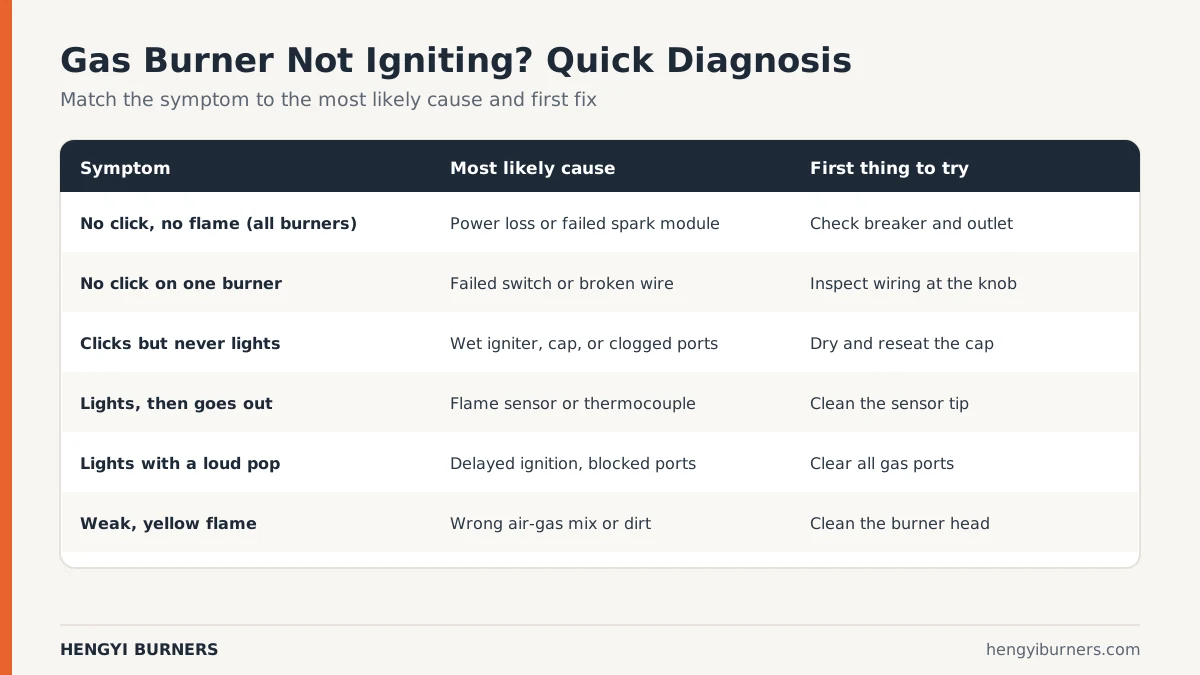
Work through this table before you start disassembling anything. It narrows the problem to a system in under a minute.
| Symptom | Most Likely Cause | First Thing to Try |
|---|---|---|
| No clicking, no flame, all burners | Power loss or failed spark module | Check breaker and outlet |
| No clicking on one burner only | Failed ignition switch or broken wire | Inspect wire under the knob |
| Clicks but never lights | Wet igniter, misaligned cap, or clogged ports | Dry and reseat the cap |
| Lights, then goes out | Flame sensor or thermocouple issue | Clean the sensor tip |
| Lights with a loud pop or boom | Delayed ignition from blocked ports | Clear all gas ports |
| Weak, yellow, or lazy flame | Wrong air-to-gas mix or dirty burner | Clean burner head thoroughly |
Step-by-Step: Cleaning and Reseating a Burner
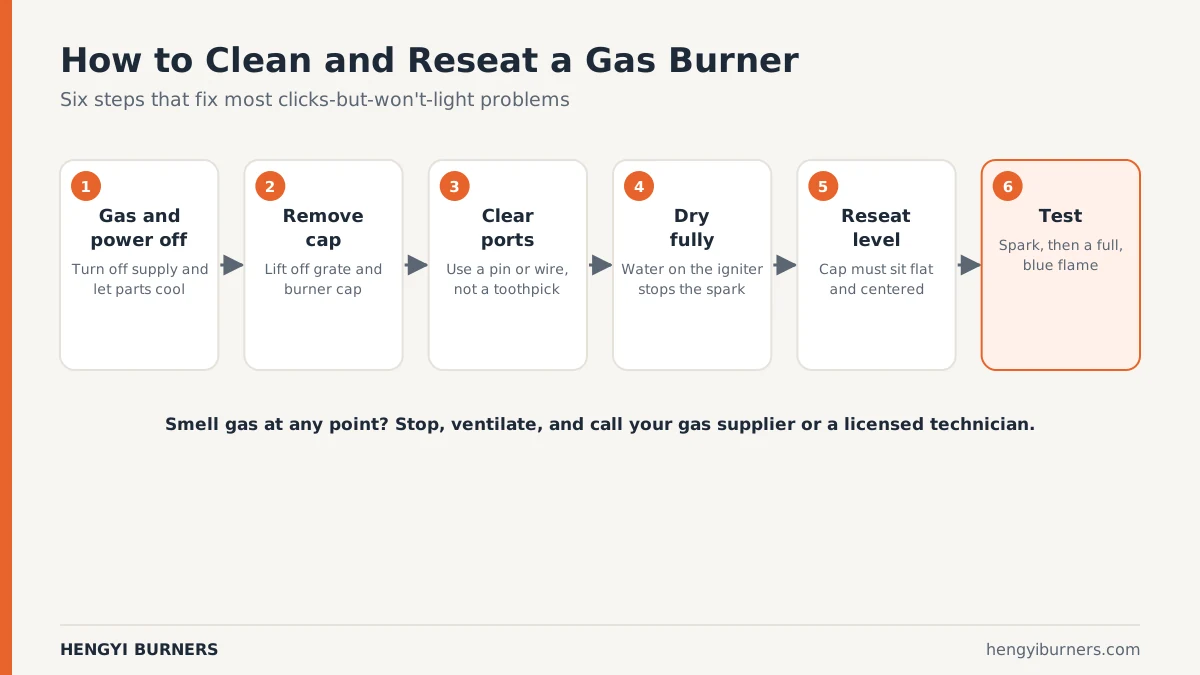
This sequence resolves most no-light complaints and takes about ten minutes per burner.
- Turn off the gas and power. Close the shutoff valve behind the range and unplug it, or flip the breaker.
- Let everything cool. Burner grates and heads hold heat for a long time.
- Remove the grate and burner cap. Set them aside on a dry towel.
- Lift out the burner head if your model allows it. Many slide straight up off the orifice.
- Brush the gas ports with a nylon brush or a straightened paper clip. Work around the full ring.
- Wipe the igniter dry. A dry microfiber cloth only — no liquids, no sprays.
- Check the electrode gap against your manual’s specification.
- Reassemble in reverse order, making sure the cap sits flat with no rocking.
- Restore gas and power, then test with a burner you know was working first.
Pro Tip: Test the burner with the cap removed and the room ventilated, just for a second, to confirm the igniter is sparking at all. If you see a clean blue arc, the ignition system is fine and the problem is gas or airflow.
When It’s a Gas Supply Problem
Gas supply issues are the ones that deserve the most caution. A burner that gets spark but no gas will click indefinitely. Before you assume a mechanical failure, confirm the shutoff valve behind the range is open and that no other gas appliance in the house has stopped working. If the water heater and furnace are also out, the problem is upstream of your range and belongs to your gas utility, not a repair technician.
If you smell gas — a sulfur or rotten-egg odor — don’t troubleshoot. Don’t flip switches. Leave the building and call your gas utility’s emergency line from outside. The U.S. Consumer Product Safety Commission publishes safety guidance on gas appliances and carbon monoxide, which is worth reading before any DIY gas work.
Warning: Never use a match or lighter to manually light a burner that has electronic ignition. If gas has been accumulating while you troubleshoot, a manual light can cause a flash fire.
Common Causes by Brand
Different manufacturers have known quirks, and knowing yours saves time.
| Brand | Frequent Issue | Notes |
|---|---|---|
| GE | Igniter electrode corrosion | Common on older profiles; electrode replacement is straightforward |
| Whirlpool | Burner cap seating | Caps must align with the locating pin exactly |
| Samsung | Moisture in the igniter | Very sensitive to boil-overs; dry thoroughly |
| LG | Spark module failure | Often affects multiple burners at once |
| Frigidaire | Clogged gas ports | Narrow ports block easily with grease |
| Bosch | Electrode gap drift | Gap specification is tighter than most brands |
What a Repair Typically Costs
If cleaning doesn’t solve it, here’s what to expect. These are typical U.S. ranges, not quotes.
| Repair | Typical Parts Cost | Typical Total With Labor |
|---|---|---|
| Igniter electrode replacement | $15–$40 | $120–$220 |
| Spark module replacement | $40–$120 | $180–$350 |
| Ignition switch replacement | $20–$60 | $140–$260 |
| Burner valve replacement | $50–$150 | $220–$420 |
| Full burner assembly | $60–$200 | $250–$450 |
A service call alone usually runs $75–$150 before any parts. On a range under warranty, check the manufacturer’s coverage first — burner and ignition components are often covered, though labor may not be.
Safety Rules You Should Not Skip
- Never ignore a gas smell, even a faint one.
- Never spray aerosol cleaner onto an igniter while it’s installed.
- Never force a burner cap that won’t seat — you’ll bend the electrode.
- Always shut off gas and power before removing any burner component.
- Always ventilate the kitchen while testing.
- Always call a licensed technician for anything behind the burner assembly.
When to Call a Technician
Call a professional if any of the following apply: the spark module needs replacement, the burner valve is faulty, the gas manifold is involved, you’ve cleaned and reseated everything and it still won’t light, or you smell gas at any point.
Gas work beyond the burner assembly is regulated in most jurisdictions, and in many states a homeowner may not legally perform it. A licensed technician has the tools to test gas pressure at the orifice and confirm the manifold is delivering the correct supply — something you can’t safely verify with household equipment.
Frequently Asked Questions
Why does my gas burner click but not light?
The igniter is sparking but the gas isn’t igniting. The usual causes are a wet or greasy igniter, a burner cap that isn’t seated flat, clogged gas ports, or an electrode gap that’s too wide. Dry the igniter, reseat the cap, and clear the ports with a paper clip before assuming a part has failed.
Why does only one burner fail to light?
A single failing burner points to a localized problem: a dirty igniter, a misaligned cap, clogged ports on that burner head, or a broken wire running to that specific ignition switch. Since the spark module serves all burners, a module failure would affect every burner, not just one.
Can I light a gas burner with a match?
You should not. On an electronically ignited range, manually lighting a burner that has been clicking can cause a flash fire if gas has accumulated. If you must light a burner manually in an emergency, ventilate first and use a long-reach lighter, never a match held close to the surface.
Why does my burner light with a loud pop?
A pop or boom means gas has been accumulating before ignition — delayed ignition. It’s usually caused by clogged gas ports or a burner cap that’s slightly off, which lets gas pool before the spark reaches it. Clear the ports and reseat the cap; if it persists, have the burner valve checked.
How do I clean a gas igniter safely?
Turn off the gas and power, let the burner cool completely, and wipe the igniter with a dry microfiber cloth. Never use water, spray cleaners, or abrasive pads on the ceramic element. If residue is stubborn, a soft nylon brush used dry is the most aggressive tool you should use.
Is a clicking gas burner dangerous?
Clicking itself isn’t dangerous, but clicking while gas flows is. If you smell gas during the clicking, shut off the burner and the supply valve immediately and ventilate the kitchen. Persistent clicking with no ignition and no gas smell is usually just a dirty or misaligned igniter.
Conclusion
Start with the simplest fix: turn everything off, let the burner cool, and clean and reseat the cap and igniter. That single step resolves most no-light complaints, and if it doesn’t, you’ll at least know whether you’re dealing with a spark problem or a gas problem — which tells you exactly who to call next.
Get the Right Parts from Hengyi Burners
Hengyi Burners manufactures infrared gas burners and burner components in Zhaoqing, China. We supply ignition needles and ignition controllers matched to our infrared gas burners. Contact our team with your fuel type, supply pressure and heating area, and we will recommend a setup and send a quote.
One thought on “Why Is My Gas Burner Not Igniting? Common Causes and Solutions”