
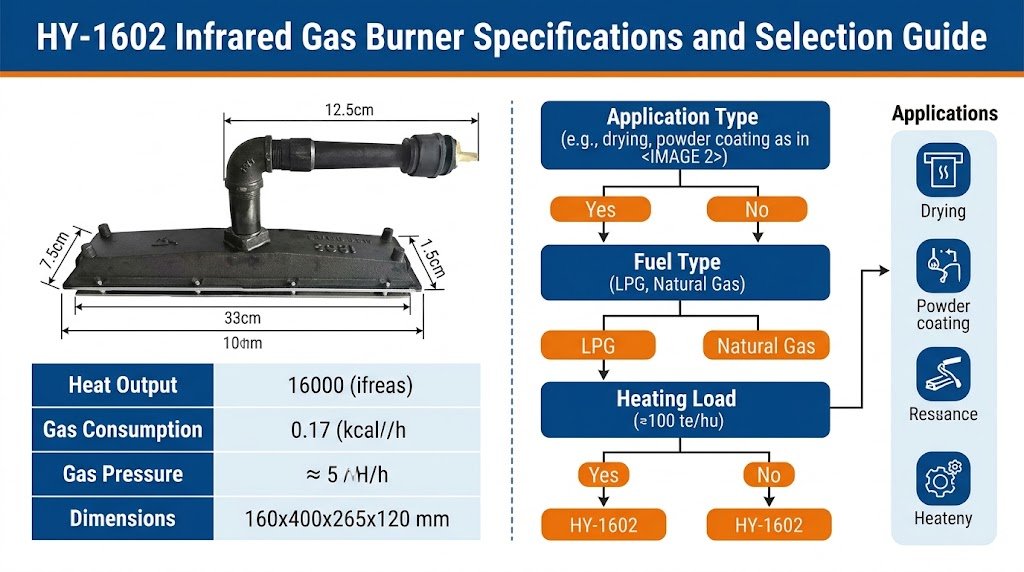
The HY-1602 infrared gas burner delivers high radiant heat through porous cordierite ceramic plates, operating at thermal outputs between 5.4 kW and 6.5 kW under low gas pressure. For industrial heating lines and commercial food processing, this guide gives the verified dimensions, gas supply figures, and ducting requirements that prevent surface scorch and incomplete combustion.
How the infrared burner works
The HY-1602 burner is an atmospheric, surface-combustion heating unit built with a cast iron body and micro-porous cordierite ceramic plaques. It heats industrial powder coating tunnels, drying lines, and large commercial rotisseries by transferring energy primarily through infrared waves rather than hot air currents. A common misconception is that infrared burners push hot air across a chamber like convection blowers do. They don’t.
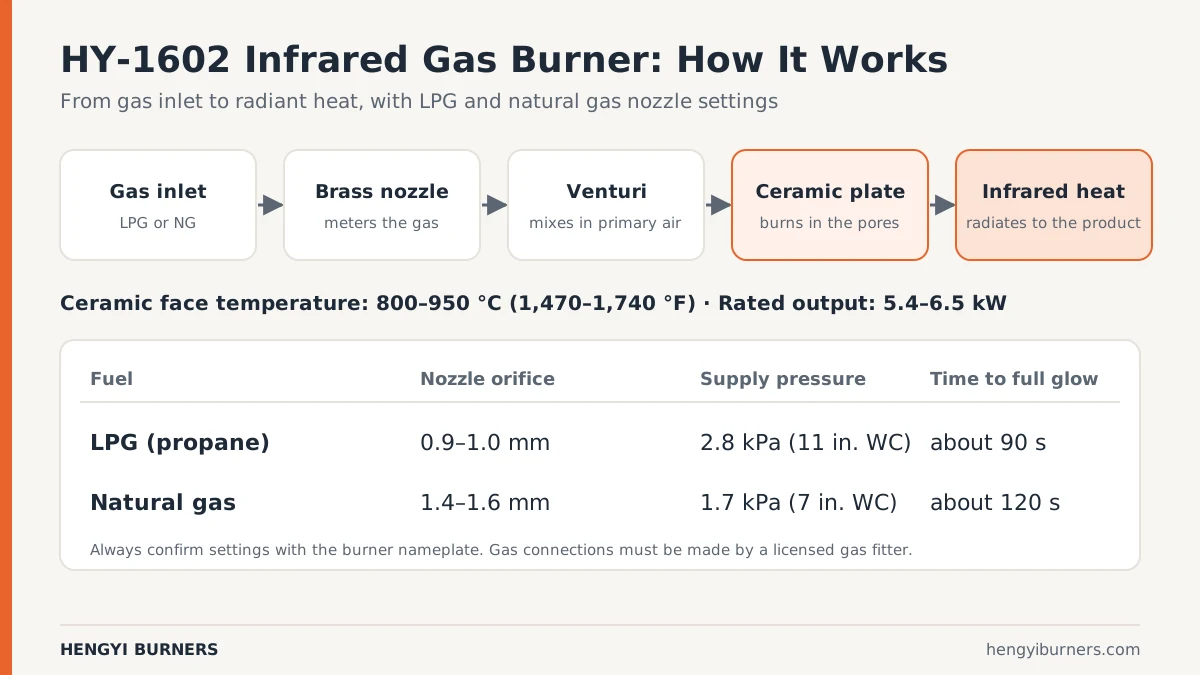
Instead, combustion takes place inside thousands of tiny pores across the ceramic face, heating the outer plaque surface to temperatures between 1,470°F and 1,740°F (800°C to 950°C). The glowing ceramic transfers radiant electromagnetic energy directly into target surfaces without warming the intermediate air first.
This model suits equipment builders, paint curing line operators, and food machinery engineers who need focused, controllable thermal transfer. It’s not for small enclosed home appliances or unvented workshops. It works on either Liquefied Petroleum Gas (LPG) or Natural Gas (NG), provided you install the correct injector nozzle orifice.
The basic method
Installing and commissioning an HY-1602 radiant burner requires precise alignment and leak-tested fuel lines:
- Mount the cast iron burner housing horizontally or facing downward at an angle no steeper than 45 degrees, maintaining at least 12 inches (300 mm) of clearance from combustible walls.
- Select the fuel orifice: thread in a 0.9 mm to 1.0 mm brass nozzle for LPG lines, or a 1.4 mm to 1.6 mm nozzle for low-pressure Natural Gas.
- Apply gas-rated PTFE tape to the 1/4-inch or 3/8-inch NPT fuel inlet threads and tighten the union with two counter-holding wrenches to avoid cracking the cast iron shell.
- Set the incoming fuel pressure regulator to 11 inches water column (2.8 kPa) for LPG, or 7 inches water column (1.7 kPa) for standard Natural Gas supplies.
- Apply a soapy water leak solution across all joint unions before introducing an open flame, watching for expanding bubbles for 60 seconds.
- Open the fuel supply, energize the high-voltage pulse igniter, and hold the safety flame solenoid open for 10 to 15 seconds until the ceramic face ignites evenly.
- Observe the plaque face during initial firing; it should shift from a faint blue surface flutter to an even, cherry-red glow within 90 to 120 seconds.
The single judgment call that separates a clean burn from premature burner failure is ceramic face color consistency. If parts of the plaque stay dark while other sections glow bright orange, the air-to-gas ratio inside the venturi throat is unbalanced. Adjust the rotating air shutter sleeve until the honeycomb face displays a uniform red hue without lifting flames. Because fuel-gas work carries explosion and carbon monoxide risks, all gas line hookups must be handled by a licensed gas fitter.
HY-1602 Fuel Settings by Application
Fuel delivery and thermal output change depending on the installation setup and fuel source.
| Situation | What to use | How long | What to watch for |
|---|---|---|---|
| LPG Line (Commercial Roasting) | 0.95 mm nozzle at 2.8 kPa | 90 seconds to full glow | Soot buildup on meat trays |
| Natural Gas (Curing Tunnel) | 1.50 mm nozzle at 1.7 kPa | 120 seconds to full glow | Fluttering flame lift at plaques |
What separates good results from bad ones
Preparation and Manifold Spacing
Experienced fabricators calculate manifold spacing before cutting any sheet metal. In drying tunnels, burners should be mounted between 8 and 14 inches (200 to 350 mm) away from the passing target product. If you place them closer than 8 inches, radiant intensity concentrates into narrow hot strips that blister paint and scorch organic matter. If you mount them past 15 inches, radiant efficiency falls off sharply, forcing you to burn extra gas to maintain tunnel temperatures.
Technicians verify line pressure while the entire array is firing, not just during idle state. When several burners share a manifold, static pressure drops the moment three or four solenoids open together. If line pressure dips below 6.5 inches water column on Natural Gas, back-pressure can pull the flame front back inside the mixing tube.
Venturi Tuning and Heat Protection
During mid-run checks, observe the venturi throat and air collar. A mistake people make is sealing the burner intake inside an airtight enclosure, assuming outside air isn’t needed. This suffocates the primary air draw, causing rich combustion that deposits black soot over the white cordierite plaques. Soot blocks microscopic ceramic pores, which ruins radiant output and requires costly burner replacement. Keep the surrounding air fresh and clean, free of airborne dust, lint, or solvent vapors.
Common problems and quick fixes
When an infrared burner underperforms, the physical flame behavior reveals the root problem.
| What you notice | What it usually means | What to do first |
|---|---|---|
| Loud popping sound (flashback) | Gas pressure is too low or nozzle is loose | Increase regulator pressure; tighten the brass jet |
| Flame rolls across ceramic surface | Primary air shutter is closed too far | Loosen sleeve screw and open primary air opening |
| Ceramic stays dark gray, no red glow | Fuel pressure too high or blocked gas jet | Check inlet pressure; clear the jet with compressed air |
| Patchy yellow flames over tiles | Cracked ceramic plate or failed gasket seal | Shut off gas immediately; replace the damaged burner tile |
Industrial Standards and Gas Rules
Installing industrial infrared gas hardware requires strict adherence to building, fire, and mechanical codes. In the United States, installations must comply with the fuel gas safety parameters defined in the NFPA 54 National Fuel Gas Code, which regulates pipe sizing, shut-off valve locations, and vented clearance spaces. When installed inside paint spray booths or curing operations, industrial ovens must align with process hazard requirements set by the NFPA 86 Standard for Ovens and Furnaces.
Furthermore, combustion equipment venting must satisfy the indoor workplace carbon monoxide limits enforced under OSHA standard 1910.1000, which caps permissible airborne carbon monoxide exposure at 50 parts per million (ppm) averaged over an eight-hour shift. If exhaust extraction drops below safe thresholds, workers face carbon monoxide hazards. Any high-pressure manifold tie-in, internal tunnel electrical wiring, or pressure regulator adjustment demands a certified gas technician equipped with an electronic flue-gas analyzer.
Burner Maintenance and Surface Care
Cordierite ceramic plates hold up under thousands of heating cycles, but they can’t handle physical impact or thermal shock from liquid water. Never wipe glowing or hot ceramic plaques with a damp cloth or spray them with liquid degreasers; the rapid local cooling will shatter the cordierite substrate instantly.
Regularly, or whenever burner face coloring becomes streaky, blow clean, oil-free dry compressed air across the ceramic faces from a distance of 6 to 8 inches.
When to use a different approach
The HY-1602 infrared burner is a radiant heater, making it a poor choice for deep convection baking where thick products require uniform, swirling air temperatures. For bread baking or delicate pastries, a direct-fired atmospheric burner will burn the outer crust while leaving the center raw. In that situation, switch to an indirect forced-air convection heat exchanger.
Similarly, if your process takes place in dusty environments like wood-sanding facilities, radiant ceramic plates will quickly clog with fine sawdust, creating severe fire hazards. For those environments, steam-coil radiators or sealed electric duct heaters with positive-pressure air filtration are the safer, more durable heating choice.
Frequently asked questions
Can the HY-1602 burner be mounted vertically?
Yes, you can mount it vertically, but only if the plaque face remains shielded from falling debris or dripping grease. In vertical orientations, check that radiant heat rising from the lower edge doesn’t overheat your gas connection line or electronic ignition leads positioned above the body.
Why is my infrared burner burning with a blue flame instead of glowing red?
Blue surface flames mean too much secondary air or low gas supply pressure. If fuel velocity drops, the mixture burns above the tiles instead of inside the micro-pores. Increase line pressure to the burner rating or close the primary air shutter slightly until the ceramic glows red.
Is it safe to use this burner indoors without a chimney?
No, it’s not safe. The HY-1602 consumes substantial oxygen and discharges carbon dioxide and water vapor directly into the room. Industrial use requires forced-draft exhaust hoods or dedicated mechanical flues to prevent toxic carbon monoxide accumulation inside the working facility.
What happens if water splashes on the glowing ceramic plate?
The ceramic tiles will crack from thermal shock. Cordierite withstands intense, steady heat, but sharp temperature drops split the porous matrix. Once cracked, raw gas leaks through the break, producing uneven yellow flames that ruin the burner’s efficiency and risk melting the cast housing.
How long does the ceramic plate take to reach operating temperature?
About 90 to 120 seconds under rated line pressure. The ceramic face initially flickers with tiny blue flames, quickly transitioning to a dull orange, and reaches its full radiant temperature between 1,470°F and 1,740°F once the manifold stabilizes.
Final Thoughts
Choosing the right heating solution doesn’t have to be a headache. Once you’ve confirmed your facility’s gas pressure and ventilation needs, you’ll be ready to integrate these burners into your production line. Reach out to our technical support team today if you’d like a custom layout plan for your specific workspace.
Get the Right Parts from Hengyi Burners
Hengyi Burners manufactures infrared gas burners and burner components in Zhaoqing, China. See the HY-1602 infrared gas burner and HY-2402 infrared gas burner, or browse all infrared gas burners. Contact our team with your fuel type, supply pressure and heating area, and we will recommend a setup and send a quote.
Related guides
One thought on “HY-1602 Infrared Gas Burner Specifications and Selection Guide”