
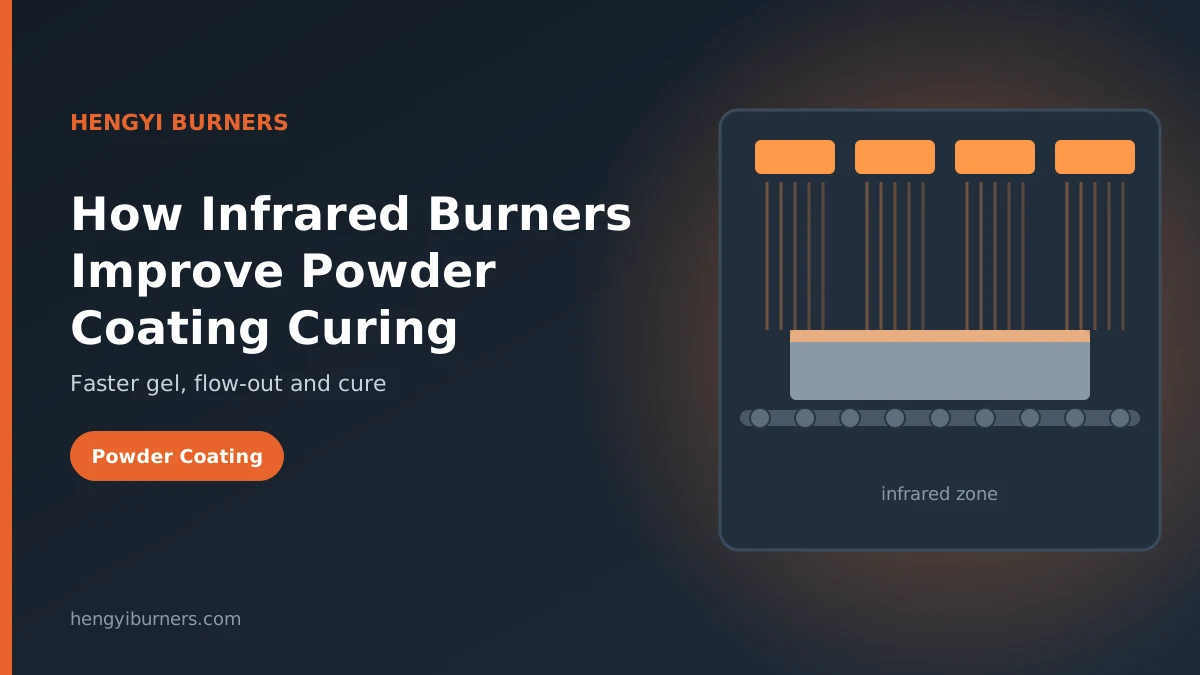
Infrared burners improve powder coating curing by transferring heat directly to the part through electromagnetic radiation, so the powder gelates and flows in seconds to minutes instead of the 10–20 minutes a convection oven needs just to bring the substrate up to temperature. That speed changes the economics, the finish quality, and the range of parts you can coat — and it comes with its own rules for oven design, emitter selection, and process control.
Key Takeaways
- Infrared heats the part, not the air. Radiant energy is absorbed by the substrate, so ramp times drop from minutes to seconds and you stop paying to heat oven walls and conveyor air.
- Match the emitter wavelength to the part. Medium-wave and short-wave emitters suit different materials and line speeds; the wrong match wastes energy on the wrong surface.
- IR is usually a booster, not a replacement. Most production lines pair a radiant zone with a convection hold so complex geometry and shadowed areas still reach full cure.
- Cure is a time-and-temperature relationship, not a time alone. Verify with the powder maker’s data sheet and a substrate temperature profile, not by watching the coating gloss over.
- Controls and zoning decide your results. Closed-loop pyrometry, zone-by-zone power control, and correct part-to-emitter distance matter more than raw burner wattage.
- Safety and code compliance are non-negotiable. Powder booths and ovens fall under fire and electrical codes that govern ventilation, interlocks, and clearances.
Why Convection Curing Slows You Down
Traditional curing ovens are convection systems. They heat air, the air heats the part surface, and the part surface conducts heat inward. That chain of transfers is slow and lossy. Air is a poor conductor, so a large share of the burner’s energy goes into heating the oven shell, the conveyor, the hangers, and the exhaust stream rather than the coating.
For a thick steel weldment, the part itself becomes a heat sink. The oven has to soak the whole mass until the substrate reaches the powder’s required cure temperature — often 350–400 °F (about 175–205 °C) for a typical thermoset powder. Only then does the clock for the chemical crosslinking reaction really start.
That’s why convection lines are long. A cure schedule of 10 minutes at temperature can mean a 25–40 minute total oven transit once you account for ramp time. The oven footprint, the gas bill, and the conveyor length all follow from that physics.
Infrared changes the heat transfer path. Instead of heating air and waiting, radiant emitters send energy that the coating and substrate absorb directly. The ramp becomes a matter of how fast the surface absorbs radiation, not how fast air can give up heat.
What Infrared Actually Does to Powder
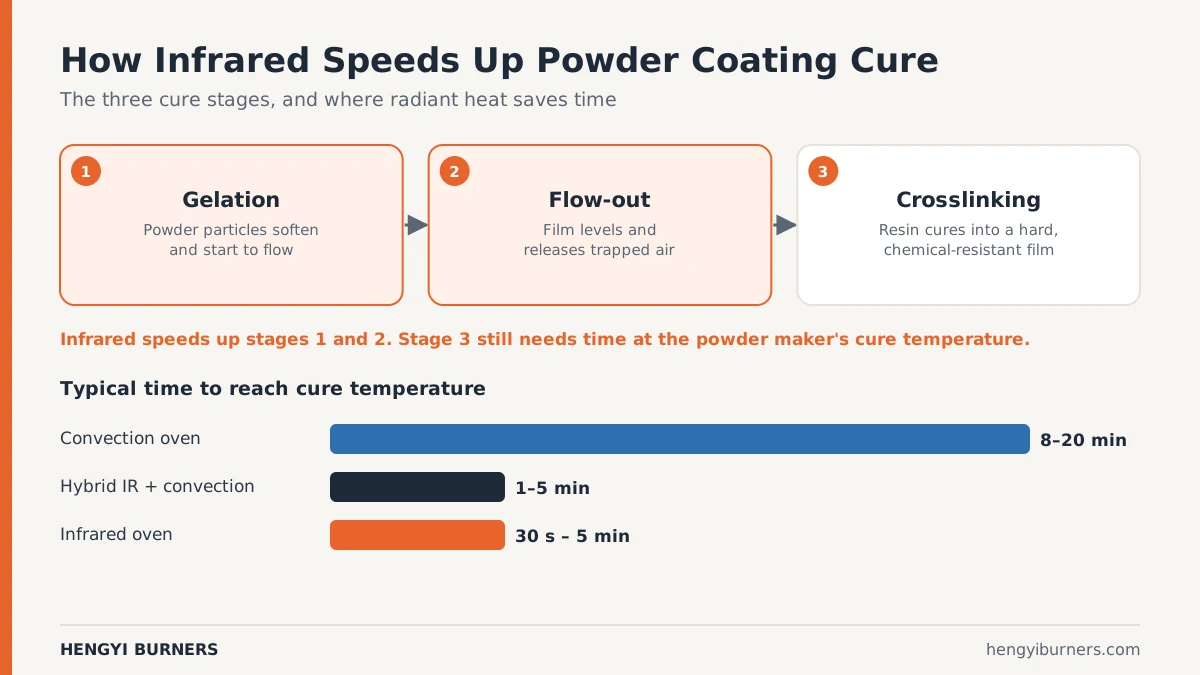
Powder cure happens in stages. First the particles gelate — they soften and begin to flow into a continuous film. Then they flow out to level the surface and release trapped air. Finally the resin system crosslinks into a thermoset network that gives the film its hardness, adhesion, and chemical resistance.
Infrared accelerates the first two stages dramatically because the energy arrives at the coating surface. The gel and flow window can shrink from minutes to seconds, which is why IR lines can produce a smooth, level film very quickly. The crosslinking stage, however, is still governed by the powder chemistry and the substrate temperature. You can’t shortcut the chemistry by throwing more radiant power at it — you’ll just bake the surface before the film is fully cured.
This is the key insight for anyone designing a line: IR is superb at getting the part to temperature fast, and it’s the hold phase that determines whether the coating actually cures. That’s why hybrid ovens dominate.
Infrared vs Convection: A Direct Comparison
| Factor | Convection Oven | Infrared Oven | Hybrid (IR + Convection) |
|---|---|---|---|
| Heat transfer | Air to part | Radiation to part | Radiation, then air |
| Typical ramp to cure temp | 8–20 minutes | 30 seconds – 5 minutes | 1–5 minutes |
| Energy goes to | Air, walls, conveyor, part | Mostly the part | Part first, then air |
| Best for | Complex 3D parts, large loads | Flat or simple shapes, high line speed | Most production powder lines |
| Shadowed areas | Fully heated | Can be under-cured | Convection finishes the job |
| Substrate sensitivity | Gentle, uniform | Can overheat thin or dark parts | Balanced |
| Footprint | Large | Compact | Medium |
| Control complexity | Low | Moderate to high | High |
The table makes the trade-off obvious. Convection is forgiving but slow. Infrared is fast but directional. The hybrid approach buys speed without gambling on the geometry.
The Main Types of Infrared Emitters
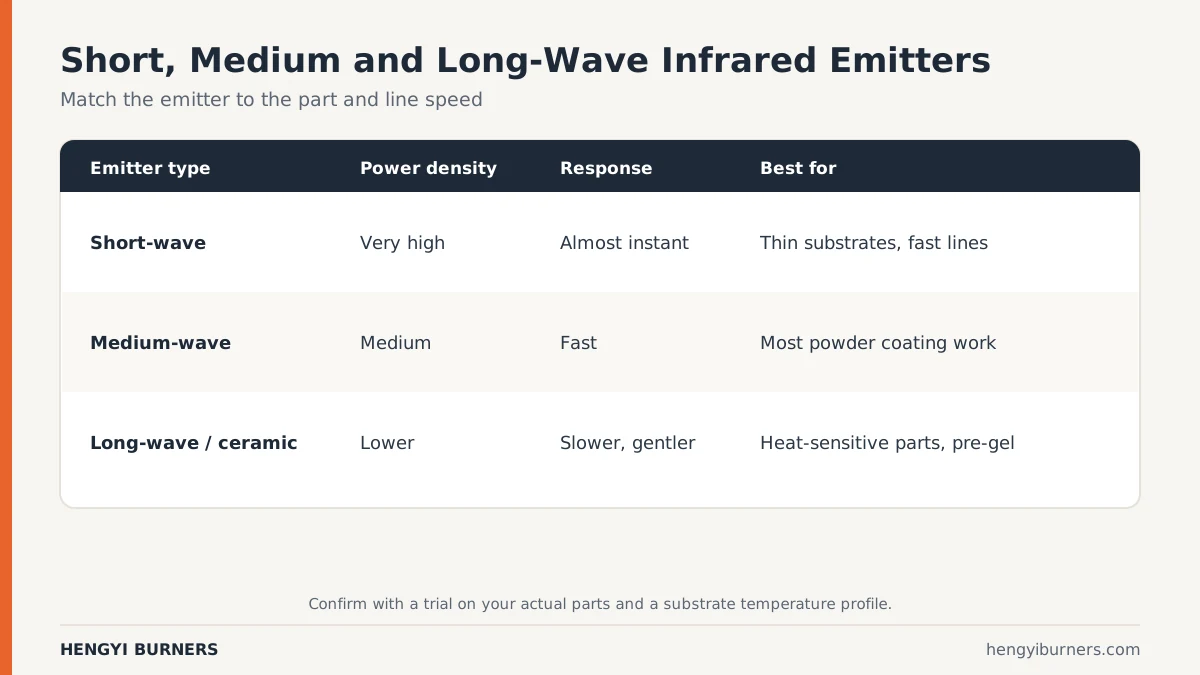
Not all infrared is the same. Emitters are classified by the wavelength band they produce, and that band determines how deeply and how efficiently a given material absorbs the energy.
Short-Wave (High-Intensity) Emitters
These are typically quartz halogen or similar lamps operating at high filament temperatures. They deliver very high power density and reach peak output almost instantly. They’re excellent for thin substrates, high line speeds, and applications where you want a fast surface response. The downside is that they can overheat thin gauge metal or dark-colored parts quickly, and they’re less efficient on materials that reflect or transmit their wavelength.
Medium-Wave Emitters
Medium-wave emitters — often quartz tubes or ceramic elements — produce a broader spectrum that many organic coatings and metals absorb well. They’re the workhorse for powder coating because they balance penetration and surface heating. They tolerate more distance variation and are less likely to scorch a film.
Long-Wave and Ceramic Emitters
Long-wave emitters run cooler and deliver lower power density. They’re slower but gentler, which suits heat-sensitive substrates, thick films, and pre-gel zones where you want controlled flow rather than a fast flash.
Selection rule of thumb: match the emitter’s peak wavelength to the absorption characteristics of both the powder and the substrate, then confirm with a trial on your actual parts. Emitter manufacturers publish spectral data; use it.
Designing an Infrared Curing Zone
Getting IR right is an engineering exercise, not a shopping decision. The following variables drive results.
Emitter-to-Part Distance
Radiant intensity falls off with distance. Moving emitters closer raises power density on the part but narrows the coverage footprint and increases the risk of hot spots. Most installations use a distance that balances uniformity against intensity, and many use reflectors to shape the energy.
Zoning and Power Control
A single-zone IR oven is a blunt instrument. Production lines typically divide the oven into zones — a pre-gel zone, a flow zone, and a cure-assist zone — each with independent power control. This lets you ramp the coating gently, then push energy where it’s needed.
Conveyor Speed and Line Balancing
Line speed sets the dwell time in each zone. If the IR zone is too short for the required dose, you either slow the line (losing the speed advantage) or raise power (risking over-cure). Line balancing is where the real engineering effort goes.
Reflectors and Shielding
Polished reflectors bounce wasted radiation back onto the part. Shields and masks keep energy off hangers, fixtures, and sensitive components. Both improve efficiency and reduce maintenance.
Pro Tip: Instrument the oven with thermocouples or non-contact pyrometers on a test part before you commit to a recipe. A substrate temperature profile tells you more in one run than a week of guesswork.
Where Infrared Wins — and Where It Doesn’t
Infrared isn’t a universal upgrade. It pays off in specific situations and disappoints in others.
Strong fits:
- Flat panels, sheet metal, and simple extrusions
- High-volume lines where cycle time is the constraint
- Thick steel parts that take forever to soak in convection
- Pre-gel zones ahead of a convection hold
- Lines with limited floor space
Weak fits:
- Deeply recessed or shadowed geometry
- Mixed part loads with wildly different masses
- Heat-sensitive substrates near their distortion limits
- Low-volume job shops where recipe development cost outweighs speed gains
For complex parts, the honest answer is usually a hybrid: IR to gel and flow the visible surfaces fast, convection to finish cure in the recesses. That combination is what most modern powder lines actually run.
Process Control and Quality Checks
Speed means nothing if the coating fails a year later. Control the process with data.
| Check | What It Confirms | Typical Method |
|---|---|---|
| Substrate temperature profile | Part reached cure temp and hold time | Thermocouple or IR pyrometer on test part |
| Gel and flow observation | Coating leveled before crosslinking | Visual inspection at zone exit |
| Film thickness | Coverage within spec | Magnetic or eddy-current gauge |
| Cure verification | Crosslink density adequate | Solvent rub, MEK double rub, or DSC |
| Adhesion | Bond to substrate | Crosshatch or pull-off test |
| Color and gloss | No overbake or underbake | Spectrophotometer or gloss meter |
Warning: Overbaking is the most common IR failure mode. Because radiant energy arrives fast, an inattentive recipe can crosslink the surface while the film underneath is still flowing, producing orange peel, poor adhesion, or a yellowed finish. Always verify with a cure test, not just a visual pass.
Energy, Cost, and Payback
Infrared ovens often cut energy use because they don’t heat the whole oven volume and exhaust stream. The savings depend on part mix, line utilization, and how much of the existing convection load you replace. A hybrid line that uses IR only for the ramp phase can cut cure-zone gas consumption substantially while keeping the convection hold short.
The capital side is more nuanced. IR emitters, reflectors, controls, and pyrometry add cost, and the oven may need more sophisticated safety interlocks. Payback usually comes from throughput — more parts per hour through the same building — rather than from the utility bill alone. Model both before you buy.
Safety and Compliance Basics
Powder coating ovens handle combustible dust and solvent vapors, and IR ovens add concentrated heat sources. Design and operation fall under fire and electrical codes, and the specific requirements depend on your jurisdiction and the powder chemistry you run.
Key practices include:
- Interlocked ventilation that proves airflow before burners or emitters energize
- Correct clearances between emitters and combustible materials
- Grounding and bonding of the conveyor and parts to control static
- Dust control in the booth and around the oven entry
- Documented lockout/tagout for maintenance on hot zones
Warning: Never bypass an interlock to speed up a line. The interlock exists because a powder oven can accumulate combustible dust and vapor, and an ignition source in the wrong place is a serious hazard. Confirm your installation against the applicable code and your insurer’s requirements before startup.
Frequently Asked Questions
How much faster is infrared curing than convection?
For a typical steel part, infrared can reach cure temperature in 30 seconds to 5 minutes, while a convection oven may need 8–20 minutes just to ramp. Total cycle time savings of 50–80 percent are common on simple geometry, but the gain shrinks on complex parts that still need a convection hold for shadowed areas.
Can I use infrared alone without a convection oven?
Sometimes, but only for parts with simple geometry and uniform mass. Flat panels and extrusions can cure fully in an IR-only line. Parts with recesses, deep channels, or mixed thicknesses usually under-cure in shadowed areas, so most production lines use a hybrid IR-plus-convection configuration.
What wavelength infrared is best for powder coating?
Medium-wave emitters are the most common choice because many powders and metals absorb that band well and it’s forgiving on distance. Short-wave works for thin, fast-moving parts but risks scorching. Long-wave suits gentle pre-gel and heat-sensitive substrates. Always confirm against the powder maker’s data and a trial run.
Does infrared curing affect powder coating appearance?
It can, in both directions. Properly controlled IR produces excellent flow and leveling because the coating gels quickly. Poorly controlled IR causes orange peel, blistering, or yellowing from overbake. Appearance problems almost always trace back to the recipe and zone control, not the technology itself.
What substrate temperature do I need for powder cure?
Most thermoset powders require a substrate temperature around 350–400 °F (175–205 °C) for a specified hold time, often 10 minutes, though low-temperature and UV-cure powders exist. The exact figure comes from the powder manufacturer’s technical data sheet — always cure to that specification, not to a visual cue.
Is infrared curing safe for my facility?
Yes, when installed and operated to code. The hazards are the same as any powder oven — combustible dust, solvent vapor, and hot surfaces — plus concentrated radiant heat. Interlocked ventilation, correct clearances, grounding, and documented maintenance keep the risk controlled. Check local fire codes and your insurer’s requirements.
Conclusion
Infrared won’t fix a bad powder recipe or a poorly grounded conveyor, but it will cut your cure time dramatically when it’s matched to your parts and paired with a convection hold. Start by running a substrate temperature profile on your highest-volume part, then talk to an oven integrator about zoning and emitter selection for that specific geometry.
Get the Right Parts from Hengyi Burners
Hengyi Burners manufactures infrared gas burners and burner components in Zhaoqing, China. See the HY-1602 infrared gas burner and HY-2402 infrared gas burner, or browse all infrared gas burners. Contact our team with your fuel type, supply pressure and heating area, and we will recommend a setup and send a quote.
3 thoughts on “How Infrared Burners Improve Powder Coating Curing”